
St Andrews Old Course
St Andrews Old Course — the Home of Golf
No course in the world carries the weight of the St Andrews Old Course. On this ancient links beside the North Sea, golf has been played since the 15th century, kings and caddies have walked the same turf, and the game’s greatest champions have written their names into its history. To stand on the first tee here is to stand at the very source of the game.
The Old Course at St Andrews is a public links in St Andrews, Fife, on Scotland’s east coast — revered as the “Home of Golf” and likely the oldest course in the world. It plays to a par of 72 over about 7,305 yards from the championship tees, famous for its vast shared double greens, fearsome named bunkers and the wind off the sea. It has hosted The Open Championship a record 30 times, most recently in 2022.
Key Details
- Location: St Andrews, Fife, Scotland
- Length: about 7,305 yards (championship tees)
- Par: 72
- Designers: evolved over centuries, with Allan Robertson and Old Tom Morris among its shapers
- Established: golf documented here since 1552 (played since the 15th century)
- Notable Events: The Open Championship (30 times, most recently 2022), Women’s British Open, Senior Open, Alfred Dunhill Links Championship
History and significance
The Old Course is a living chronicle of the game. Golf has been played on these links since at least the early 1400s, with the first documented record in 1552, and the ground was ratified as common land as far back as 1123 — it remains a public course to this day, managed by the St Andrews Links Trust so that anyone can play it.
The course shaped golf itself. In 1754 the Society of St Andrews Golfers — later the Royal & Ancient Golf Club, whose clubhouse sits beside the first tee — was founded here. In 1764 the layout was reduced from 22 holes to 18, establishing the standard round that the whole world now plays. Its form was refined over the years by early professionals such as Allan Robertson and the legendary Old Tom Morris.
It has staged The Open Championship 30 times, more than any other venue, from Tom Kidd in 1873 to Cameron Smith’s record-breaking 20-under victory at the 150th Open in 2022. It was here, too, that Bobby Jones completed part of his 1930 Grand Slam; his love of the place was such that he was later given the freedom of the town. For millions of golfers, a round at St Andrews is nothing less than a pilgrimage.
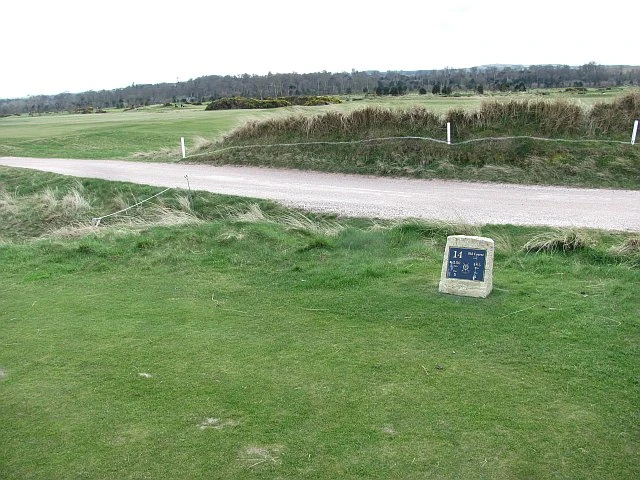
Photos via geograph.org.uk (CC BY-SA 2.0)
The course and how it plays
The Old Course is a links like no other, and much of its character comes from its greens: seven enormous double greens, where two holes share a single putting surface, so an approach must be judged not just for distance but for which acre of green the flag sits on. The greens are vast but deceptively subtle, full of slopes and borrows that reward local knowledge — which is why a caddie is worth their weight in gold.
Then there are the bunkers. Small, deep and revetted, they carry fearsome names — Hell, Coffin, Grave, the Beardies — and a single misjudged shot can drop you into one with only a sideways or backward escape. Hell Bunker on the long 14th is the most notorious of all, a sprawling pit that has wrecked many a card.
The fairways are wide and firm, encouraging the running approach that is the essence of links golf, but they hide their own dangers, and out-of-bounds and gorse punish the wayward. Above all there is the wind: sweeping in off the North Sea, it changes direction and strength from hour to hour, turning a gentle hole into a brute and demanding constant thought over club and shot shape. As Jack Nicklaus put it, “St Andrews is not just a golf course; it’s a state of mind.”
Signature holes
The Old Course is studded with holes that every golfer knows by name.
Hole 1 (Burn)
One of the most famous opening holes in golf. The fairway shared with the 18th is enormous, but the tee shot must find its line and the approach carries the Swilcan Burn, a small stream that has swallowed many a nervy first swing. Simple in outline, heavy with history — the perfect start to a St Andrews round.
Hole 11 (High / the Eden)
A short par three of around 170 yards played towards the Eden estuary, and one of the most admired short holes in the world. The green slopes sharply from back to front and is ringed by deep bunkers, including the notorious Strath. Into the sea wind, choosing the right club is pure guesswork — a hole where a three feels like a triumph.
Hole 17 (Road Hole)
Widely regarded as the toughest par four in championship golf. The blind drive must be carried over the corner of the old railway sheds, and the long approach is played to a slender green defended by the fearsome Road Hole Bunker on one side and a stone wall and road on the other. Too bold and you find the road; too cautious and you find the sand. It has decided Opens and broken hearts in equal measure.
Hole 18 (Tom Morris)
A short, drivable-looking par four that finishes in the heart of the town, crossing the Swilcan Bridge — the most photographed spot in golf — before an approach that must avoid the deep swale known as the Valley of Sin, short of the green. Walking up the 18th at St Andrews, with the R&A clubhouse and the grey town beyond, is a moment every golfer dreams of.
Why play St Andrews Old Course
Playing the Old Course is a pilgrimage that goes far beyond a round of golf. It is a chance to walk where Bobby Jones, Jack Nicklaus, Seve and Tiger have walked, to cross the Swilcan Bridge, and to test yourself on the double greens, the named bunkers and the ever-present wind that have defined the game for six centuries. And because it is public, that dream is open to everyone — scratch player or high handicapper alike. There is nowhere in golf quite like it.
Clubhouse and facilities
As part of the St Andrews Links complex, the Old Course is served by excellent modern facilities. There is a large clubhouse with dining serving Scottish fare, a well-stocked pro shop full of exclusive St Andrews merchandise, and a practice range to warm up. Above all, caddie services are on hand — local experts whose knowledge of the greens, bunkers and wind can transform a first-timer’s round into a guided journey through the game’s history.
Green fees and booking
The Old Course is a public course and welcomes visitors, but demand is enormous and green fees sit at the top end of the game. A single round typically ranges from around £150 in the depths of winter to around £340 at peak summer.
Tee times are allocated by advance application and a daily ballot rather than simple online booking, and a handicap limit applies, so it pays to plan well ahead. For current green fees and tee times, check the official website.
Getting there and parking
St Andrews sits on the Fife coast, easily reached from Scotland’s main cities.
- By car: about 1 hour 30 minutes from Edinburgh (roughly 50 miles) via the A91, or around 2 hours from Glasgow via the M80 and A91.
- By public transport: ScotRail trains run to Leuchars, from where it is a short bus or taxi ride into St Andrews.
- Address & parking: St Andrews Links, St Andrews, Fife, KY16 9SF, with parking near the course; the compact town is very walkable.
Where to stay
The town of St Andrews wraps right around the links, so you can stay within a short walk of the first tee:
- Beside the links: landmark hotels overlooking the course offer the ultimate stay-and-play, some with views down the 18th.
- In the town: a wide choice of hotels, guesthouses and B&Bs in the historic centre, all close to the golf and the sights.
- For a wider trip: the rest of Fife and even Edinburgh (under two hours) work as bases if you are touring.
Book well ahead — St Andrews is busy year-round and demand around the golf is high.
What to pack
Exposed east-coast links golf, so plan for the wind whatever the forecast:
- Waterproof jacket and trousers, plus a windproof mid-layer
- A warm layer and a hat for the North Sea breeze
- Spare gloves and plenty of extra balls for the gorse and bunkers
- Sturdy, well-fitting golf shoes for firm, running links turf
- A camera for the Swilcan Bridge — you will want the photograph
Nearby attractions
St Andrews is a treasure of history and coast, with plenty to enjoy beyond the links.
| Attraction | Appeal | Distance |
|---|---|---|
| British Golf Museum | The story of the game, steps from the first tee | ~2 min |
| St Andrews Cathedral & St Rule’s Tower | Medieval ruins with panoramic views over the town and links | ~10 min |
| St Andrews Castle | 13th-century clifftop fortress with mine and bottle dungeon | ~10 min |
| West Sands Beach | Vast sandy beach made famous by Chariots of Fire | Beside the course |
| University of St Andrews | One of the world’s oldest universities, founded 1413 | ~5 min |
Conclusion
Every golfer should stand on the first tee at St Andrews at least once. The Old Course is not the longest or the flashiest links in the world, but it is the most important — six centuries of the game distilled into eighteen holes, open to all, beside the grey old town and the sea. Play it, cross the Swilcan Bridge, and you carry a little of golf’s soul home with you.
Frequently asked questions
When was the St Andrews Old Course established?
Golf has been played on the St Andrews links since at least the early 1400s, with the first documented record in 1552, making the Old Course very likely the oldest golf course in the world. The land was ratified as common ground in 1123 and remains public today. The course helped define the modern game: it was here that the 18-hole round became standard in 1764, and the Royal & Ancient Golf Club, founded in 1754, sits beside the first tee.
What is the Old Course’s par and length?
The Old Course plays to a par of 72 over about 7,305 yards from the championship tees, though it is far more about strategy than length. Its seven vast double greens, deep revetted bunkers and the constant North Sea wind make it a supreme test of thought and touch rather than power. From the forward tees it plays much shorter, so golfers of all standards can enjoy walking golf’s most historic links.
What are the most famous holes at St Andrews?
The most celebrated is the par-four 17th, the “Road Hole”, widely rated the hardest par four in championship golf, with its blind drive and green squeezed between the Road Hole Bunker and a stone wall and road. The 1st, with its approach over the Swilcan Burn, and the 18th, crossing the famous Swilcan Bridge to a green guarded by the Valley of Sin, are icons too, as is the short 11th (High / the Eden) with its wickedly sloping green.
Has the Old Course hosted The Open?
Yes — more than anywhere else. St Andrews has hosted The Open Championship 30 times, the most of any venue, from Tom Kidd’s win in 1873 to Cameron Smith’s record 20-under victory at the 150th Open in 2022. It has also staged the Women’s British Open and the Senior Open, and hosts the annual Alfred Dunhill Links Championship. Bobby Jones famously won the 1930 British Amateur here as part of his Grand Slam, deepening the course’s legendary status.
How do I get to St Andrews?
St Andrews is on the Fife coast, about 1 hour 30 minutes by car from Edinburgh via the A91, or around two hours from Glasgow via the M80 and A91. By public transport, ScotRail trains run to Leuchars, from where it is a short bus or taxi ride into the town. The address is St Andrews Links, St Andrews, Fife, KY16 9SF, with parking near the course and a compact, walkable town centre right beside the links.
Are there other courses nearby?
Yes — St Andrews Links itself has several other courses, including the New, Jubilee, Eden, Strathtyrum, Balgove and the modern Castle Course, all part of the same public complex. The wider Fife coast is rich in links golf too, from Kingsbarns and Elie to Crail. It is one of the greatest concentrations of golf anywhere, making St Andrews the perfect base for a golfing trip.
Carnoustie Golf Links (Championship)
Carnoustie Golf Links: golf's fiercest examination They call it "Car-nasty", and one look at the closing holes tells you why. The Barry Burn coils across the fairways like a trap set centuries ago, the wind bites off the North Sea, and the great names of the game have...
Kingsbarns Golf Links
Kingsbarns Golf Links: a modern links that plays like it always was Stand on the first tee at Kingsbarns and it is hard to believe the course is younger than most of the golfers on it. The North Sea crashes below, the fairways ripple away over three great plateaus,...
North Berwick Golf Club (West Links)
North Berwick Golf Club: the quirkiest great links of all Few opening tees frame a view like this one. Bass Rock rises black out of the Firth of Forth, the beach curls away beneath you, and the salt breeze carries four centuries of golf. The West Links at North...
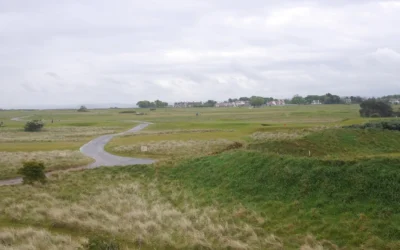
Muirfield Golf Course (Gullane)
Muirfield Golf Course: the fairest test in golf There is a reason players speak of Muirfield with something close to reverence. Stand on the links above the Firth of Forth, with the Fife coast shimmering across the water and the wind never quite still, and you sense...
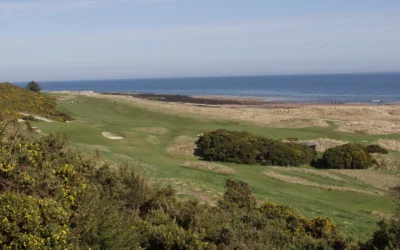
Royal Dornoch Golf Club (Championship)
Royal Dornoch Golf Club: golf at the edge of the Highlands Stand on the first tee at Royal Dornoch and the world falls quiet. The Dornoch Firth glints away to your right, gorse spills gold across the dunes in early summer, and the fairways run firm and fast toward the...