
Royal Dornoch Golf Club (Championship)
Royal Dornoch Golf Club: golf at the edge of the Highlands
Stand on the first tee at Royal Dornoch and the world falls quiet. The Dornoch Firth glints away to your right, gorse spills gold across the dunes in early summer, and the fairways run firm and fast toward the sea. It feels less like a round of golf and more like a pilgrimage to the game in its purest form.
Royal Dornoch Golf Club’s Championship Course is a classic Highland links in Dornoch, Sutherland, in the far north of Scotland. It measures 6,754 yards to a par of 70, laid out by Old Tom Morris in 1886 on links where golf has been played since at least 1616. Remote, natural and almost unchanged, it is regularly named among the finest courses in the world.
Key Details
- Location: Dornoch, Sutherland, Scotland
- Length: 6,754 yards (Blue tees)
- Par: 70
- Designers: Old Tom Morris (extended to 18 holes, 1886)
- Established: 1877 (club); golf recorded here since 1616
- Notable Events: British Amateur Championship (1985); Scottish Amateur (1993, 2000, 2012, 2023); Senior Amateur Championships (2022)
History and significance
Golf has been played on the Dornoch linksland since at least 1616, when town records note the cost of a young aristocrat’s clubs — making this one of the oldest golfing sites anywhere. The Royal Dornoch Golf Club was formally founded in 1877 with a nine-hole course.
In 1886 Old Tom Morris travelled up from St Andrews to extend the layout to eighteen holes, working the natural dunes and ridges into a course that survives largely intact today. King Edward VII granted the club its “Royal” title in 1906.
Its remoteness has kept the professional tours away, but Royal Dornoch has staged major amateur golf, from the 1985 British Amateur to a run of Scottish Amateur Championships. Its deepest mark on the game, though, was made by a local son: Dornoch-born Donald Ross learned his craft here as greenkeeper and professional before shaping American classics such as Pinehurst No. 2 — his signature crowned greens a direct echo of home.
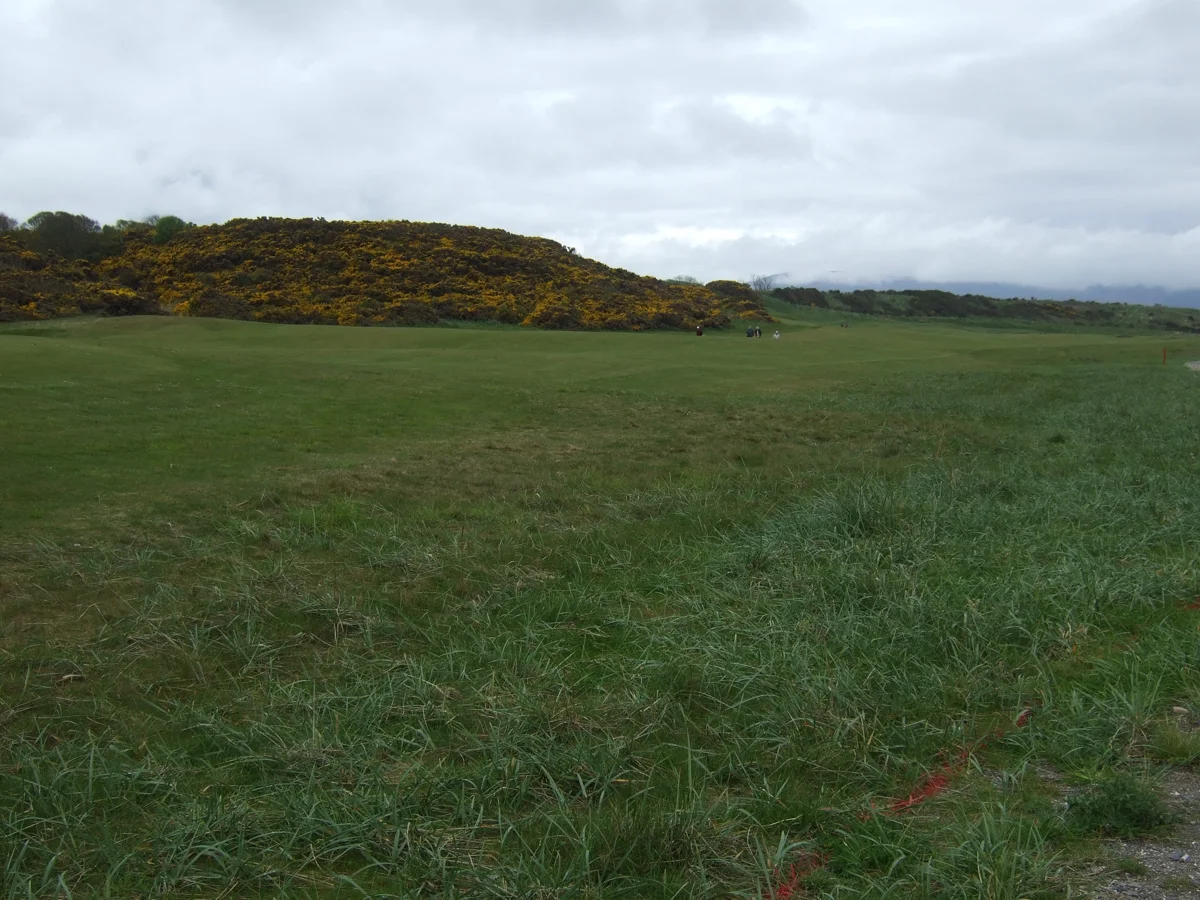
Image credits: Featured image: Mick Crawley / geograph.org.uk (CC BY-SA 2.0). Body image: JThomas / geograph.org.uk (CC BY-SA 2.0).
The course and how it plays
Royal Dornoch is a classic out-and-back links strung along the sandy shore of the Dornoch Firth. The opening eight holes run out along an elevated ridge with the sea below you, before the round turns for home on the lower ground nearer the beach — the traditional shape that leaves you exposed to whatever the wind is doing.
The firm, fast fairways beg for the running ground game, but the course’s true defence sits at the greens. Many are domed and elevated — “upturned saucers” — shedding anything less than a precise approach off their sides and into trouble. Deep pot bunkers and gorse-lined fairways punish the wayward, and club selection into the breeze is a constant puzzle.
Length varies beautifully, from short, tempting par 4s to demanding long ones, so every club in the bag gets used. This is a course won with brains rather than brawn — position, flight and judgement matter far more than raw power.
Signature holes
Dornoch’s reputation rests on a handful of genuinely great holes rather than a single showpiece.
Hole 14 (Foxy)
A par 4 of around 445 yards and Dornoch’s most celebrated hole — remarkably, with not a single bunker. “Foxy” is a natural double dog-leg that demands you shape the drive to open a line to a plateau green set at an angle across your approach. The green’s steep front repels weak shots, and many players sensibly run the ball on. Pure, cunning, natural architecture.
Hole 17 (Valley)
A par 4 of about 417 yards and one of Scotland’s finest. The tee shot must find a fairway squeezed between dunes and gorse, before an approach to a green framed by the sea beyond — precision is everything.
Hole 6 (Whinny Brae)
A par 3 of roughly 161 yards marking the shift up to the higher ground. The shot is played across gorse to a plateau green guarded by deep bunkers, with subtle borrows and the ever-present wind making club choice critical — a quintessential links short hole.
Why play Royal Dornoch
Few courses reward thoughtful golf like Dornoch. Its variety asks questions of strategy and touch rather than strength, and the firm turf and quick greens invite creative shot-making that suits every standard of player. Add the sense of playing a Morris layout that time has barely touched, in one of Scotland’s most beautiful and peaceful corners, and the appeal is obvious. Tom Watson, an honorary member, called it “the most fun I’ve had on a golf course.”
Clubhouse and facilities
The understated clubhouse looks straight out over the links and serves breakfast, lunch and dinner with a Highland accent — hearty, local and welcoming rather than grand. The pro shop is well stocked with equipment, clothing and club-branded souvenirs.
Practice facilities near the clubhouse include driving nets, a short-game area and a putting green, with a separate practice ground available. A club professional offers lessons, and the club’s second eighteen, the well-regarded Struie Course, gives visitors the chance to make a full day of it.
Green fees and booking
Royal Dornoch welcomes visitors to the Championship Course through the year, with tee times most sought-after in summer. A single round typically ranges from around £215 in the quieter winter months to around £360 at peak season.
Summer tee times are highly competitive and often book out many months in advance, so plan well ahead. For current green fees and tee times, check the official website.
Getting there and parking
Dornoch sits in the far north, but it is more accessible than its remoteness suggests.
- By car: from Inverness, head north on the A9 for about 45 miles, then follow the signs into Dornoch — roughly an hour. Edinburgh and Glasgow are a three-to-four-hour drive.
- By public transport: take the train to Inverness, then a Stagecoach bus (the X99 corridor) or a taxi on to Dornoch, about an hour from the city.
- Address & parking: Golf Road, Dornoch, Sutherland IV25 3LW. Ample on-site visitor parking.
Where to stay
Dornoch itself is the natural base, a handsome little town a short walk from the first tee.
Beside the links, the Royal Golf Hotel sits just yards from the opening hole for the shortest possible commute to your tee time. In the town centre you will find a good spread of hotels, guesthouses and B&Bs within easy reach of the course. For a wider Highland trip, nearby Tain or the countryside toward Golspie open up more options while keeping Dornoch within a comfortable drive.
What to pack
This is exposed northern links golf, so plan for wind and sudden changes. Bring reliable waterproofs, warm layers even in summer, a windproof top and a spare glove. Sturdy, well-gripping golf shoes suit the firm, undulating turf, and a rangefinder helps on a course where domed greens disguise distance.
Nearby attractions
| Attraction | Appeal | Distance |
|---|---|---|
| Dornoch Cathedral | Medieval parish church from 1239, with gargoyles and fine stained glass | In town |
| Dornoch Beach | Blue Flag beach of golden sand, ideal for walks and family time | 1 mile |
| Historylinks Museum | Award-winning local museum covering Donald Ross and the town’s Pictish and Viking past | In town |
| Skibo Castle | Storied Highland castle estate set in grand grounds | 5 miles |
| Dunrobin Castle | Fairy-tale 19th-century castle with opulent interiors and falconry displays | 12 miles |
| Loch Fleet Nature Reserve | Tidal basin near Golspie rich in seals and seabirds | 9 miles |
Conclusion
Royal Dornoch asks for a long journey and repays it many times over. It is golf reduced to its essentials — firm turf, wild dunes, brilliant greens and a sea breeze — laid out by a master and left, wisely, almost alone. Make the trip north once and you will understand why so many golfers spend the rest of their lives trying to get back.
Frequently asked questions
Where is Royal Dornoch Golf Club?
Royal Dornoch Golf Club is in Dornoch, in the county of Sutherland in the Scottish Highlands, on the northern shore of the Dornoch Firth. It is around 45 miles north of Inverness by road, roughly an hour’s drive, and about three to four hours from Edinburgh or Glasgow. Its far-northern setting is a big part of the experience: this is remote, unspoiled links golf, well away from the crowds of the central belt.
Who designed the Championship Course at Royal Dornoch?
The Championship Course was extended to eighteen holes by Old Tom Morris in 1886, building on the nine-hole layout the club had used since its founding in 1877. Morris shaped the course around the natural dunes and ridges, and it has changed remarkably little since. The links are also closely tied to Dornoch-born Donald Ross, who learned the game and his greenkeeping craft here before going on to design many of America’s most famous courses.
What is the Foxy hole at Royal Dornoch?
“Foxy” is the 14th, a par 4 of around 445 yards and the course’s most famous hole. It is unusual in having no bunkers at all — its defence is entirely natural. A double dog-leg fairway asks you to position the drive carefully to open a line to a plateau green set at an angle, with a steep front that turns away anything under-hit. It is widely regarded as one of the great natural par 4s in golf.
Is Royal Dornoch suitable for higher handicappers?
The Championship Course is a serious test, but it rewards strategy and touch rather than brute strength, so thoughtful higher handicappers can enjoy it greatly. The club’s second eighteen, the Struie Course, is more forgiving and a good choice for beginners or those wanting a gentler round. Check the club’s official website for current visitor information, tee times and any handicap requirements before you travel.
Carnoustie Golf Links (Championship)
Carnoustie Golf Links: golf's fiercest examination They call it "Car-nasty", and one look at the closing holes tells you why. The Barry Burn coils across the fairways like a trap set centuries ago, the wind bites off the North Sea, and the great names of the game have...
Kingsbarns Golf Links
Kingsbarns Golf Links: a modern links that plays like it always was Stand on the first tee at Kingsbarns and it is hard to believe the course is younger than most of the golfers on it. The North Sea crashes below, the fairways ripple away over three great plateaus,...
North Berwick Golf Club (West Links)
North Berwick Golf Club: the quirkiest great links of all Few opening tees frame a view like this one. Bass Rock rises black out of the Firth of Forth, the beach curls away beneath you, and the salt breeze carries four centuries of golf. The West Links at North...
Muirfield Golf Course (Gullane)
Muirfield Golf Course: the fairest test in golf There is a reason players speak of Muirfield with something close to reverence. Stand on the links above the Firth of Forth, with the Fife coast shimmering across the water and the wind never quite still, and you sense...
Turnberry Ailsa Course
Turnberry Ailsa Course — links drama on the Ayrshire coastFew courses stir the soul like the Ailsa. Running along the rugged Ayrshire shore beneath its famous white lighthouse, with the volcanic hump of Ailsa Craig on the horizon and the Firth of Clyde crashing below,...