
Carnoustie Golf Links (Championship)
Carnoustie Golf Links: golf’s fiercest examination
They call it “Car-nasty”, and one look at the closing holes tells you why. The Barry Burn coils across the fairways like a trap set centuries ago, the wind bites off the North Sea, and the great names of the game have both triumphed and unravelled here. Carnoustie is widely regarded as the toughest test in Open golf — and that reputation is the very reason golfers make the trip.
The Carnoustie Championship Course is a classic links on the Angus coast in eastern Scotland, playing to a par of 72. It has hosted The Open Championship eight times, from Tommy Armour in 1931 to Francesco Molinari in 2018, and stages a share of the Alfred Dunhill Links Championship. Firm, exposed and relentless, it asks more questions than almost any course in the world.
Key Details
- Location: Carnoustie, Angus, Scotland
- Length: around 6,950 yards from the members’ championship tees (over 7,400 for The Open)
- Par: 72
- Designers: Allan Robertson and Old Tom Morris (1842); James Braid (1926 redesign)
- Established: 1842
- Notable Events: The Open Championship (1931, 1937, 1953, 1968, 1975, 1999, 2007, 2018); Senior Open (2010, 2016); Women’s British Open (2011, 2021)
History and significance
Golf has been played at Carnoustie since the 16th century — records from 1560 note local landowner Sir Robert Maule at the game. In 1842 Allan Robertson, helped by Old Tom Morris, laid out a ten-hole course that crossed and re-crossed the Barry Burn, the stream that still defines the round today. Old Tom extended it to eighteen holes in 1867.
The course took its championship shape from James Braid, the five-time Open champion, whose 1926 redesign added strategic bunkering and the rugged character needed to test the world’s best. Before the 1999 Open the bunkers were rebuilt, greens expanded and new tees added, while Braid’s routing was preserved.
Carnoustie’s eight Opens have produced some of the game’s most unforgettable moments — Ben Hogan’s masterclass in 1953, Tom Watson’s breakthrough in 1975, and, most famously, Jean van de Velde’s collapse on the 72nd hole in 1999 that handed Paul Lawrie victory in a playoff. Pádraig Harrington and Francesco Molinari added their names in 2007 and 2018.
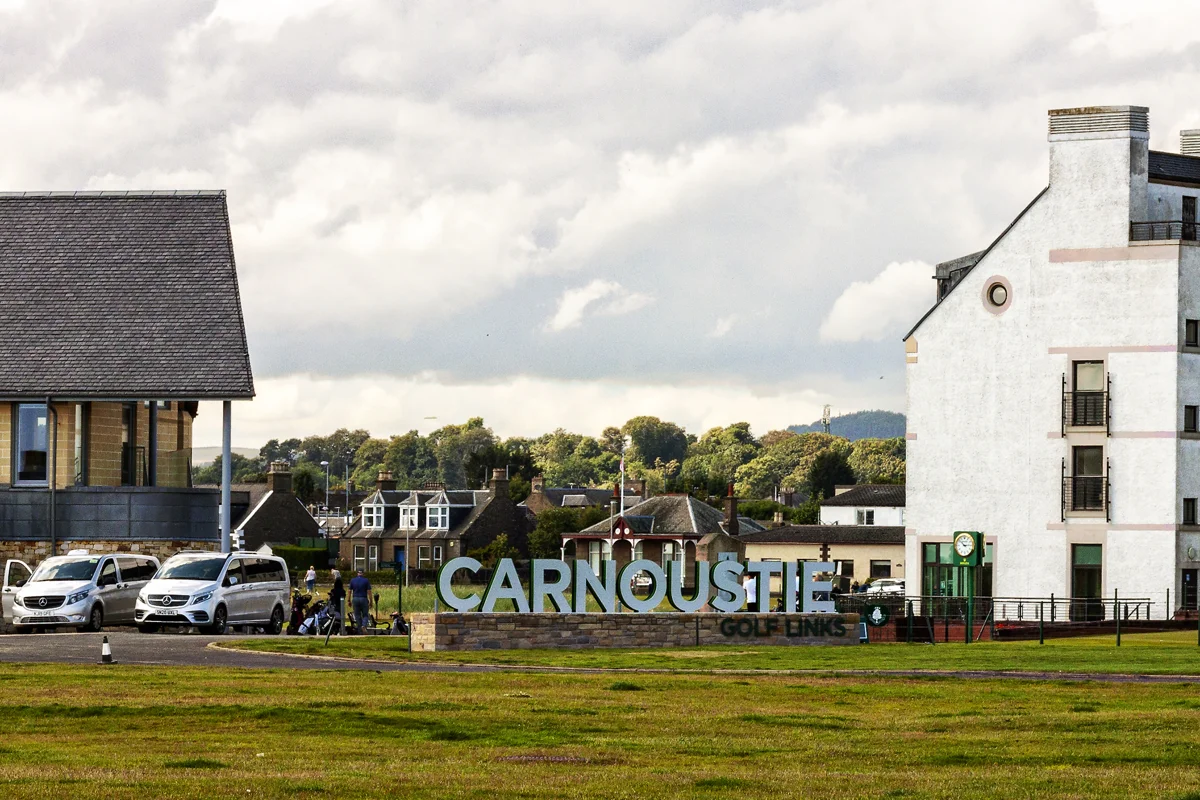
Image credits: Featured image: Jim Smillie / geograph.org.uk (CC BY-SA 2.0). Body image: Macieklew / Wikimedia Commons (CC BY-SA 4.0).
The course and how it plays
Carnoustie is a links stretched across firm, sandy turf shaped by natural bumps and hollows. Unlike many Open venues it offers only glimpses of the sea, keeping the focus on the golf itself. The fairways can look generous and tempt bold driving, but strategic bunkering and the ever-present Barry Burn demand precision, while the coastal wind can turn a fair test into a brutal one.
The course’s signature is that burn — a sinuous stream that snakes through the layout and, on the closing holes, crosses the fairways again and again. Deep, revetted bunkers, thick gorse and heavy rough punish anything wayward, and huge greens such as the 60-yard-deep 2nd test distance control. Blind shots, like the approach at the 1st, add to the examination.
What makes Carnoustie so feared is that it never lets up. There is no easy stretch to catch your breath, and the finish — through the 16th and over the Barry Burn twice on the last two holes — is among the hardest in championship golf.
Signature holes
Carnoustie’s fame rests heavily on its ferocious closing stretch.
Hole 6 (Hogan’s Alley)
A par 5 named in 2003 to honour Ben Hogan’s 1953 Open victory. The drive must thread a narrow line between bunkers and an out-of-bounds fence down the left — the daring route Hogan famously mastered — while a ditch cuts across the second shot and the undulating green demands a precise approach. A par here is hard-earned.
Hole 16 (Par 3, ~245 yards)
A brute of a short hole, stretching up to 245 yards and usually played into the wind. It asks for a long, accurate iron to a green ringed by bunkers and rough; even the world’s best struggle to hold it, and par feels like a birdie.
Hole 18 (Home, Par 4, ~499 yards)
One of golf’s most iconic finishers, forever linked to van de Velde’s 1999 drama. The drive must avoid fairway bunkers, then the approach flies over the Barry Burn, which crosses the fairway twice near the green. It has undone champions and crowned others — every shot a test of nerve.
Why play Carnoustie
Carnoustie is a crucible. Its links layout, firm fairways and unpredictable winds challenge every part of your game, and its reputation as the sternest Open venue draws golfers eager to measure themselves against its storied hazards. Yet it is a fair test as well as a fearsome one — and to stand on the 18th tee where so much history was written is worth the trip on its own.
Clubhouse and facilities
Links House, opened in 2018, is the modern heart of Carnoustie, home to a restaurant serving dishes built on local Angus produce with panoramic views over the links and Carnoustie Bay. There is a well-stocked pro shop, locker rooms and a snack area.
Rather than a traditional driving range, Carnoustie offers state-of-the-art simulator bays, alongside a practice putting green and chipping area, and a short five-hole course for a relaxed warm-up. Caddies and indoor coaching are available to help you tackle the challenge.
Green fees and booking
Carnoustie welcomes visitors to the Championship Course on limited days through the week, typically Tuesdays and Thursdays. A round on the Championship Course typically ranges from around £270 in the quieter early-season months to around £320 at peak summer, with rounds on the neighbouring Burnside or Buddon courses available at a lower add-on rate.
Booking well ahead is advised, and the club applies handicap limits on the Championship Course (broadly 28 or less for men and 36 or less for women), with fourball and foursomes play allocated to different parts of the visitor day. It is a walking course. For current green fees and tee times, check the official website.
Getting there and parking
Carnoustie is well connected on the Angus coast, with a station within walking distance.
- By car: about 12 miles east of Dundee; roughly 1.5 hours from Edinburgh via the A90, or two hours from Glasgow. From St Andrews it is around 45 minutes.
- By public transport: Carnoustie railway station, on the ScotRail network, is about a five-minute walk from the course, with regular trains from Dundee and beyond.
- Address & parking: 20 Links Parade, Carnoustie, Angus DD7 7JF. Ample on-site parking is available.
Where to stay
Carnoustie itself is the obvious base, a seaside town right beside the links.
Beside the 18th green, the Carnoustie Golf Hotel offers the most convenient stay, with views over the closing hole. The town has further hotels, guesthouses and B&Bs within easy reach of the course, while nearby Dundee, or St Andrews about 45 minutes away, widen the options for a longer golfing trip through the region.
What to pack
Carnoustie is exposed and the weather changes fast, so come ready for anything. Bring dependable waterproofs, warm layers, a windproof top and a spare glove, plus golf shoes with strong grip for firm links turf. A rangefinder helps on a course with blind shots and vast greens, and an extra club into the wind is often the difference on the long holes.
Nearby attractions
| Attraction | Appeal | Distance |
|---|---|---|
| Carnoustie Beach | Long sandy beach beside the course with a coastal path to Arbroath | By the course |
| Barry Mill | Restored 19th-century working water mill with woodland walks | 2 miles |
| Arbroath Abbey | Red-sandstone ruin where the Declaration of Arbroath was signed in 1320 | 7 miles |
| Glamis Castle | Grand castle with royal links, opulent interiors and gardens | 15 miles |
| East Haven | Quaint fishing village with a small harbour and coastal walks | 2 miles |
| Tentsmuir Forest | Nature reserve of pines, dunes and beaches, good for wildlife | 18 miles |
Conclusion
Carnoustie makes no apologies. It is hard, honest and utterly gripping — a links that has broken champions on its final holes and rewarded the brave and the precise. To play where Hogan carved his line and van de Velde met his fate is to feel the full weight of the game’s history. Tame it, or even survive it, and the round will stay with you for life.
Frequently asked questions
Where is Carnoustie Golf Links?
Carnoustie Golf Links is in the town of Carnoustie on the Angus coast of eastern Scotland, about 12 miles east of Dundee. It is roughly 1.5 hours from Edinburgh by car via the A90, two hours from Glasgow, and around 45 minutes from St Andrews. Carnoustie railway station is about a five-minute walk from the course, making it one of the more accessible Open venues. The full address is 20 Links Parade, Carnoustie, Angus DD7 7JF.
How many times has Carnoustie hosted The Open?
Carnoustie has hosted The Open Championship eight times: in 1931, 1937, 1953, 1968, 1975, 1999, 2007 and 2018. Champions here include Tommy Armour, Henry Cotton, Ben Hogan, Gary Player, Tom Watson, Paul Lawrie, Pádraig Harrington and Francesco Molinari. The 1999 Open is the most famous, remembered for Jean van de Velde’s triple-bogey on the last that let Lawrie win in a playoff. The course has also staged the Senior Open and the Women’s British Open.
What is Hogan’s Alley at Carnoustie?
Hogan’s Alley is the 6th, a par 5 named in 2003 to honour Ben Hogan’s 1953 Open victory. The hole demands a brave drive threaded between fairway bunkers and an out-of-bounds fence down the left — the tight line Hogan famously took on his way to the title. A ditch crosses the second shot and the green is subtly contoured, so a par is a genuine achievement. It is one of the most celebrated holes on the course.
Why is Carnoustie considered so difficult?
Carnoustie’s difficulty comes from a combination of factors: the winding Barry Burn that crosses the fairways repeatedly, especially on the closing holes; deep revetted bunkers and heavy rough; large, exposed greens; and a fierce coastal wind with little shelter. Crucially, the course never eases off — there is no soft stretch to score on, and the finish is among the hardest in championship golf. That relentlessness is exactly why it is regarded as the toughest test in the Open rotation.
Kingsbarns Golf Links
Kingsbarns Golf Links: a modern links that plays like it always was Stand on the first tee at Kingsbarns and it is hard to believe the course is younger than most of the golfers on it. The North Sea crashes below, the fairways ripple away over three great plateaus,...
North Berwick Golf Club (West Links)
North Berwick Golf Club: the quirkiest great links of all Few opening tees frame a view like this one. Bass Rock rises black out of the Firth of Forth, the beach curls away beneath you, and the salt breeze carries four centuries of golf. The West Links at North...
Muirfield Golf Course (Gullane)
Muirfield Golf Course: the fairest test in golf There is a reason players speak of Muirfield with something close to reverence. Stand on the links above the Firth of Forth, with the Fife coast shimmering across the water and the wind never quite still, and you sense...
Royal Dornoch Golf Club (Championship)
Royal Dornoch Golf Club: golf at the edge of the Highlands Stand on the first tee at Royal Dornoch and the world falls quiet. The Dornoch Firth glints away to your right, gorse spills gold across the dunes in early summer, and the fairways run firm and fast toward the...
Turnberry Ailsa Course
Turnberry Ailsa Course — links drama on the Ayrshire coastFew courses stir the soul like the Ailsa. Running along the rugged Ayrshire shore beneath its famous white lighthouse, with the volcanic hump of Ailsa Craig on the horizon and the Firth of Clyde crashing below,...