
Royal Cromer Golf Club
Royal Cromer Golf Club — clifftop links on the Norfolk coast
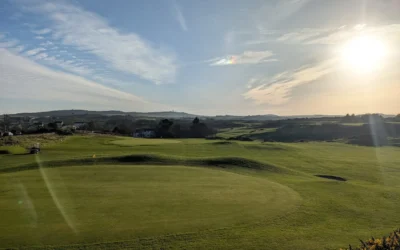
Step up to the first tee at Royal Cromer and the scale of the setting makes itself immediately felt: the North Sea stretches to the horizon, the clifftop ground rolls and dips with a natural energy quite unlike inland courses, and the wind — always the wind — announces itself as a factor from the first swing. Royal Cromer Golf Club, established in 1888 on the clifftop between Cromer and Overstrand in north Norfolk, is one of England’s oldest and most historically significant courses. Par 72 and stretching to approximately 6,544 yards from the championship tees, its layout was shaped over generations by some of the greatest names in golf architecture: Old Tom Morris, JH Taylor, James Braid, and Frank Pennick. The club was founded with royal patronage from the Prince of Wales — later King Edward VII — before it had even opened, and its role in the origins of the Curtis Cup adds an international dimension to a history rich in significance.
Key Details
- Location: Overstrand Road, Cromer, Norfolk, NR27 0JH
- Length: Approximately 6,544 yards (championship tees)
- Par: 72
- Designers: Old Tom Morris (expansion to 18 holes, 1890s); JH Taylor (redesign, 1911); James Braid (improvements, mid-1920s); Frank Pennick (later works)
- Established: 1888 (club formed 1887)
- Notable Events: Ladies’ British Amateur Open Championship (1905); Curtis Cup origins (1905); royal patronage granted by the Prince of Wales, Christmas 1887
History and significance
The story of Royal Cromer begins with a trade unionist. Henry Broadhurst MP — stonemason, prominent unionist, and Norfolk holiday-maker — noticed that the land seaward of Cromer’s lighthouse had the makings of an excellent links course. With the support of local enthusiasts, a club was formed in 1887 and Lord Suffield leased the land. Before the course had even opened, the Prince of Wales — later crowned King Edward VII — granted royal patronage, giving the club its distinctive prefix from the outset. Early in 1888, the first tee shot on the nine-hole course was struck by founder member Benjamin Bond Cabbell.
The course’s early years attracted a remarkable range of visitors. Writers including Tennyson, Conan-Doyle, and Wilde enjoyed the clifftop setting, and the popularity of the area — known romantically as ‘Poppyland’ — brought fashionable society to north Norfolk at a time when the railways had made leisure travel newly accessible. Old Tom Morris, the greatest figure in the early history of golf course design — responsible for Carnoustie, Muirfield, and the Old Course at St Andrews — was instrumental in planning the expansion to 18 holes, and his imprint can still be traced in parts of the current layout.
The club’s most celebrated contribution to golf history came in 1905, when the Ladies’ British Amateur Open Championship was held at Royal Cromer. Among the competitors were sisters Margaret and Harriet Curtis of the United States, who organised friendly international matches around the event and subsequently offered to provide a trophy for future such contests. The idea they conceived at Royal Cromer eventually became the Curtis Cup — one of women’s golf’s most prestigious team events — which was formally established in 1932. JH Taylor oversaw major course improvements in 1911, and James Braid made further significant enhancements in the mid-1920s, with Frank Pennick contributing later refinements. The course that visitors play today carries the accumulated intelligence of four generations of design.
The course and how it plays
Royal Cromer is a clifftop course, and the clifftop defines everything about how it plays. The ground is a patchwork of hummocky sandy hills, gorse, bracken, and quarry valleys — natural features that Colt, Taylor, Braid, and their predecessors used as the raw material for the routing. The sea is visible from virtually every hole, not as a distant backdrop but as an ever-present companion. In calm conditions the views are simply beautiful; in a north sea wind the same holes become a completely different examination, with club selection complicated by gusts that shift and strengthen without warning.
The fairways are built from naturally draining sandy turf that plays firm and fast when conditions allow. Gorse and bracken are the primary rough hazards: errant drives disappear into them readily and recovery shots are often the only option. The greens are well-contoured and run true, with the undulations reflecting the natural clifftop terrain rather than artificial construction. Several greens are positioned at angles that reward the golfer who has approached from a specific side of the fairway — course knowledge and attention to pin position are genuine advantages here.
The cliff edge comes into play most dramatically on the sixth hole, where a shot left means a ball over the edge. The wind changes everything: holes that seem short and manageable on the card can play a full club — or more — longer into a headwind, and the scoring on exposed clifftop holes swings dramatically with conditions. This variability is part of Royal Cromer’s charm: the course never plays quite the same way twice, and a scratch golfer who scores well in calm conditions may struggle to break 80 in a gale from the north.
Signature holes
Three holes in particular capture the spirit and challenge of Royal Cromer.
Hole 6 — Cliffhanger, par 4, approximately 400 yards
The most dramatic hole on the course, and one of the most dramatic on any clifftop course in England. The fairway runs along the cliff edge, with the left side of the hole falling away literally over the cliff. A wayward shot left risks being lost on the clifftop or beyond; the green is deceptively contoured and hard to hold from anything other than the ideal approach angle. The name captures it perfectly: there is a genuine element of danger here that no amount of experience quite removes, and the coastal views from this part of the course are extraordinary.
Hole 14 — Lighthouse, par 3, approximately 150 yards
Tony Jacklin described this hole as one of the best he had ever played, and the description is not extravagant. The sea sits to the right, gorse to the left, and the lighthouse in the middle distance provides a landmark that is both beautiful and useful for alignment. Bunkers guard the green, and the wind — as on all the coastal holes — can turn a comfortable-looking tee shot into a genuine puzzle. At approximately 150 yards the distance seems manageable, but wind, hazards, and green contour combine to make this a hole that demands respect from every golfer who plays it.
Hole 18 — Home View, par 4, approximately 400 yards
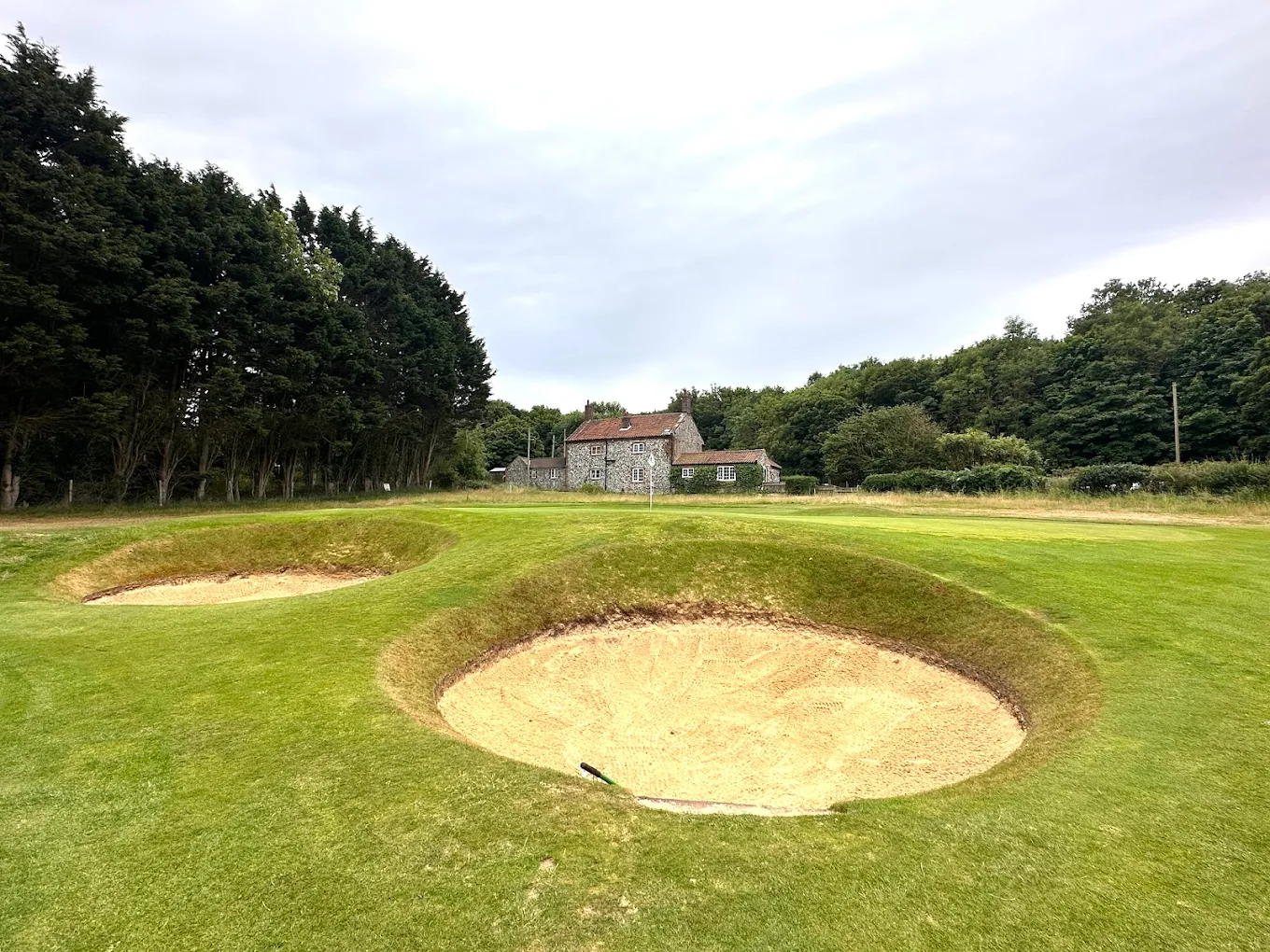
The finishing hole at Royal Cromer requires a 155-yard carry over gorse and bracken from the tee to reach the fairway — an immediate test of nerve for golfers who have battled through seventeen holes of wind and clifftop challenge. The green is double-tiered, with penal rough surrounding it, and the clubhouse in view adds a theatrical quality to the closing moments of the round. Making a par at the 18th at Royal Cromer is a genuinely satisfying way to finish a course that has earned every shot it has taken from you.
Why play Royal Cromer Golf Club
Royal Cromer offers a type of golf that is genuinely rare in England: authentic clifftop play on a course shaped by over a century of thoughtful design, with the North Sea as a constant companion and a history that touches the origins of international women’s golf. For those who believe that golf at its finest is inseparable from its setting — wind, natural terrain, and the drama of a course carved from wild ground — Royal Cromer is one of the most compelling destinations in the country. The course changes with every visit, wind and weather creating a different examination each time, and the history of the club adds a depth of interest that rewards those who take the time to learn it. It is a course that is appreciated most by golfers who value the traditions of the game as much as the challenge of the round.
Clubhouse and facilities
Royal Cromer’s clubhouse is a welcoming space befitting a club of its long history, with well-appointed changing rooms, a pro shop stocked with equipment and clothing, and a History Room — formally named the Henry Broadhurst Room — where artefacts, maps, and photographs document the club’s remarkable past. Clubhouse dining is available for visiting golfers. The club has a full-length driving range, a short-game area with a chipping green and practice bunker, and a putting green adjacent to the first tee — facilities that allow visitors to prepare properly for a course that rewards careful warm-up. Buggy and club hire are available subject to availability.
Green fees and booking
Green fees at Royal Cromer vary by season and day of the week, with peak rates during the summer months and lower rates available mid-week and during the winter season. Visitor tee times are available after specific morning slots reserved for members on weekdays and weekends. For current green fees and tee times, check the official website.
Getting there and parking
Royal Cromer is located on the North Norfolk coast, between Cromer and Overstrand, approximately two hours’ drive from central London and well connected to the broader Norfolk road network.
- By car: From Norwich, take the A140 north to Cromer (approximately 25 miles). The course is on Overstrand Road, signposted from Cromer town centre. From the A149 North Norfolk coast road, follow signs to Cromer and then Overstrand Road.
- By public transport: Cromer railway station is served by trains from Norwich (approximately 50 minutes), which connects to London Liverpool Street via Norwich. Local taxis are available from the station to the course, approximately one mile away.
- Address and parking: Overstrand Road, Cromer, Norfolk, NR27 0JH. Free car parking is available on site.
Where to stay
Cromer itself is a traditional seaside town with a good range of accommodation, and the wider North Norfolk coast offers several appealing alternatives for those wishing to combine golf with exploration of one of England’s most attractive coastlines.
- Cromer town centre: Hotels, guest houses, and self-catering properties are available throughout the town, within easy walking distance of the course. Cromer’s Victorian seafront character makes it a pleasant base in its own right.
- Overstrand and Sheringham: Smaller villages and towns along the North Norfolk coast offer bed-and-breakfast accommodation in quieter settings, typically within ten miles of the course.
- North Norfolk countryside: Several country house hotels and farmhouse B&Bs in the hinterland of the north Norfolk coast offer a more rural base, typically at competitive prices compared with seafront properties.
What to pack / gear
Royal Cromer’s clifftop setting demands respect for the elements. A waterproof jacket and windproof outer layer are essential year-round — north Norfolk weather can change rapidly, and the exposed clifftop positions make wind protection non-negotiable. Soft-spike golf shoes are required; the natural turf is precious and metal spikes are not permitted. Extra golf balls are advisable: gorse and bracken swallow errant shots efficiently. Smart golf attire — collared shirt, tailored trousers or shorts — is expected. A rangefinder or GPS is useful on a course where the wind makes accurate distance judgement particularly valuable.
Nearby attractions
| Attraction | Appeal | Distance |
| Felbrigg Hall (National Trust) | 17th-century country house with extensive woodland estate and walled garden | Approx. 2 miles |
| Blickling Estate (National Trust) | Jacobean mansion with formal gardens and parkland lake | Approx. 8 miles |
| North Norfolk Railway (Poppy Line) | Heritage steam railway between Sheringham and Holt through countryside | Approx. 5 miles |
| Cromer Museum and Pier | Victorian seaside heritage and local natural history exhibits | Approx. 1 mile |
| Sheringham Park (National Trust) | Humphry Repton-designed woodland garden with rhododendrons and sea views | Approx. 5 miles |
Conclusion
Royal Cromer Golf Club is one of England’s most historically significant golf destinations: a clifftop layout shaped by Old Tom Morris, JH Taylor, James Braid, and Frank Pennick, with a heritage stretching back to 1888 that includes royal patronage, a pivotal role in the origins of the Curtis Cup, and one of the most dramatic settings in English golf.
Frequently asked questions
What is the connection between Royal Cromer and the Curtis Cup?
The Curtis Cup — one of the most prestigious events in women’s amateur golf, contested between Great Britain & Ireland and the United States — owes its origins in part to an event held at Royal Cromer in 1905. When the Ladies’ British Amateur Open Championship was staged at the club, American sisters Margaret and Harriet Curtis participated in friendly international matches alongside the championship. Inspired by the camaraderie of those matches, they offered to provide a trophy for future such contests between British and American women golfers. The idea they conceived at Royal Cromer eventually became the Curtis Cup, which was formally established in 1932. Royal Cromer takes considerable pride in this connection to the international history of the game.
Is Royal Cromer a links course?
Royal Cromer is sometimes described as a clifftop links, though it sits on ground that differs from the classic links terrain found at courses such as Royal St George’s or Brancaster. The course is built on hummocky sandy hills, gorse-covered clifftop ground, and natural quarry valleys — land with many links-like characteristics in terms of drainage, turf quality, and the role of the wind. The sea is visible from virtually every hole and the wind is a constant factor in scoring. Whether classified strictly as a links or as a clifftop heathland course, the experience of playing Royal Cromer feels closer to seaside golf than to any inland category, and the conditions it produces — firm, fast, and wind-affected — are entirely consistent with the links tradition.
When is the best time of year to visit Royal Cromer?
Royal Cromer is playable year-round, and each season offers a distinct experience. Summer (May to September) brings the longest days, the best weather prospects, and peak visitor demand — it is the period when the clifftop views are most vivid and the course plays at its firmest. Autumn offers less busy conditions and often produces the most settled playing weather of the year. Winter and early spring are quieter, with lower green fees and a more solitary experience on the course, though the exposure to north sea weather can make rounds genuinely challenging. Serious golfers seeking the most complete test of the course might consider visiting in a shoulder season, when the course is in good condition and green fees are more accessible.
What was the role of Old Tom Morris at Royal Cromer?
Old Tom Morris — the most celebrated figure in the early history of golf course design, responsible for key work at Carnoustie, Muirfield, and the Old Course at St Andrews — was brought to Royal Cromer to oversee the expansion of the course from nine to eighteen holes in the early 1890s. Morris was not responsible for the original nine-hole layout, which predated his involvement, but his contribution to the routing of the full eighteen holes was significant. His imprint can still be traced in parts of the current course, giving Royal Cromer a direct design connection to one of the founding figures of the game. Subsequent work by JH Taylor in 1911 and James Braid in the mid-1920s built upon Morris’s foundation, and Frank Pennick made further later refinements.
Neath Golf Club
Neath Golf Club (Neath, Neath Port Talbot, Wales) Nestled high above the picturesque Neath Valley, Neath Golf Club offers a golfing experience that is as visually stunning as it is challenging. Designed by the legendary James Braid, this heathland course provides a...
Delta Hotels Marriott St Pierre Country Club
Delta Hotels Marriott St. Pierre Country Club (Chepstow, Monmouthshire, Wales) Nestled in the heart of Chepstow, Monmouthshire, Wales, the Marriott St Pierre Hotel and Country Club is a golfer’s paradise steeped in history. Set within 400 acres of rolling parkland,...

Llandrindod Wells Golf Club
Llandrindod Wells Golf Club (Llandrindod Wells, Powys, Wales) Nestled in the heart of the Welsh countryside, Llandrindod Wells Golf Club offers a golfing experience that is as much about the journey as it is about the destination. Perched on a gently undulating...
Welshpool Golf Club
Welshpool Golf Club (Welshpool, Powys, Wales) Perched atop Golfa Hill, Welshpool Golf Club is a hidden gem that promises an unforgettable golfing experience. This James Braid-designed, 18-hole course in Welshpool, Powys, Wales, captivates with its breathtaking views...
Bull Bay Golf Club
Bull Bay Golf Club (Amlwch, Isle of Anglesey, Wales) Bull Bay Golf Club, nestled on the northern coast of Anglesey, Wales, is a hidden gem that captivates golfers with its dramatic coastal setting and rich history. Imagine standing on an elevated tee, the Irish Sea...