
Moor Park Golf Club (High Course)
Moor Park High Course — Harry Colt’s championship parkland near London
Picture yourself on an elevated tee, gazing across 300 acres of mature parkland towards the elegant silhouette of a 17th-century mansion — and then realise the mansion is the clubhouse. Moor Park Golf Club in Rickmansworth, Hertfordshire is one of the most visually extraordinary settings in English golf, and the High Course that Harry Colt designed in 1923 is a fitting companion to its surroundings. At par 72 and stretching to 7,036 yards from the blue tees, the High Course is a championship-standard layout that has hosted the PGA Matchplay Championship, the Women’s British Open, and the Bob Hope British Classic, attracting some of the finest players of their respective eras. This is a course that rewards strategic play, punishes carelessness, and leaves a lasting impression.
Key Details
- Location: Rickmansworth, Hertfordshire, WD3 1QN
- Length: 7,036 yards (blue/championship tees)
- Par: 72
- Designer: Harry Colt
- Established: 1923
- Notable Events: PGA Matchplay Championship (1925); Women’s British Open (1985); Bob Hope British Classic; Carris Trophy; Hertfordshire Stag; England Golf championship events
History and significance
Golf has been played at Moor Park since 1923, when Harry Colt — widely regarded as one of the greatest golf course architects of any era — created both the High Course and the companion West Course on a magnificent Hertfordshire estate. Colt’s reputation was already established before Moor Park: he had designed Sunningdale’s New Course, Wentworth, and had been involved in major projects on both sides of the Atlantic. At Moor Park he had the considerable advantage of a spectacular landscape and the ambition to match it.
The High Course opened almost immediately to professional competition: the PGA Matchplay Championship was played here as early as 1925, a remarkable endorsement of the layout’s quality within just two years of opening. Over the following decades the club hosted a succession of major events. The Bob Hope British Classic brought the European Tour to Moor Park, and the Women’s British Open in 1985 added another chapter to the course’s championship story. The club has continued to attract prestigious amateur competition, with the Carris Trophy — one of the most celebrated amateur strokeplay events in England — a regular visitor, alongside the Hertfordshire Stag and county championship events.
The 17th-century mansion at the heart of the estate — now the clubhouse — adds a historical dimension that few golf clubs anywhere in the world can match. The estate’s long and distinguished history predates golf entirely, but the sport has been woven into the fabric of Moor Park for over a century, and the High Course carries that weight of history with each hole it unfolds.
The course and how it plays
Colt’s genius was the ability to create courses that feel inevitable in their routing — as if the holes have grown from the landscape rather than been imposed upon it. At Moor Park High Course this quality is immediately apparent. The holes thread through mature woodland and across open parkland alternately, each transition feeling natural and the variety between them keeping the mind fully engaged throughout. No two consecutive holes feel alike in character, which is a considerable achievement across 18 holes on a single piece of ground.
Length is a significant factor. From the back tees the course demands genuine power from the tee on several holes, and the combination of length with Colt’s strategic bunkering — placed to catch both the tentative and the reckless — makes scoring a serious undertaking. The course rating and slope rating for the High Course reflect a genuine championship test; this is a layout that examines every aspect of a golfer’s game across 18 holes without respite.
The terrain adds to the challenge. Elevation changes feature throughout, with the dramatic dip of the hidden gully at the 14th being perhaps the most extreme example, but the course uses contour intelligently throughout. The greens are well-guarded and feature enough movement to reward precise approach play; the wrong side of these greens leaves awkward putts and chips, while the correct side opens up birdie chances. A course that looks beautiful from the tee requires careful reading of the ground before committing to a line — and that is precisely the kind of course Colt was unmatched at designing.
Signature holes
Three holes illustrate most vividly what makes the High Course exceptional.
Hole 8 — par 4, 494 yards
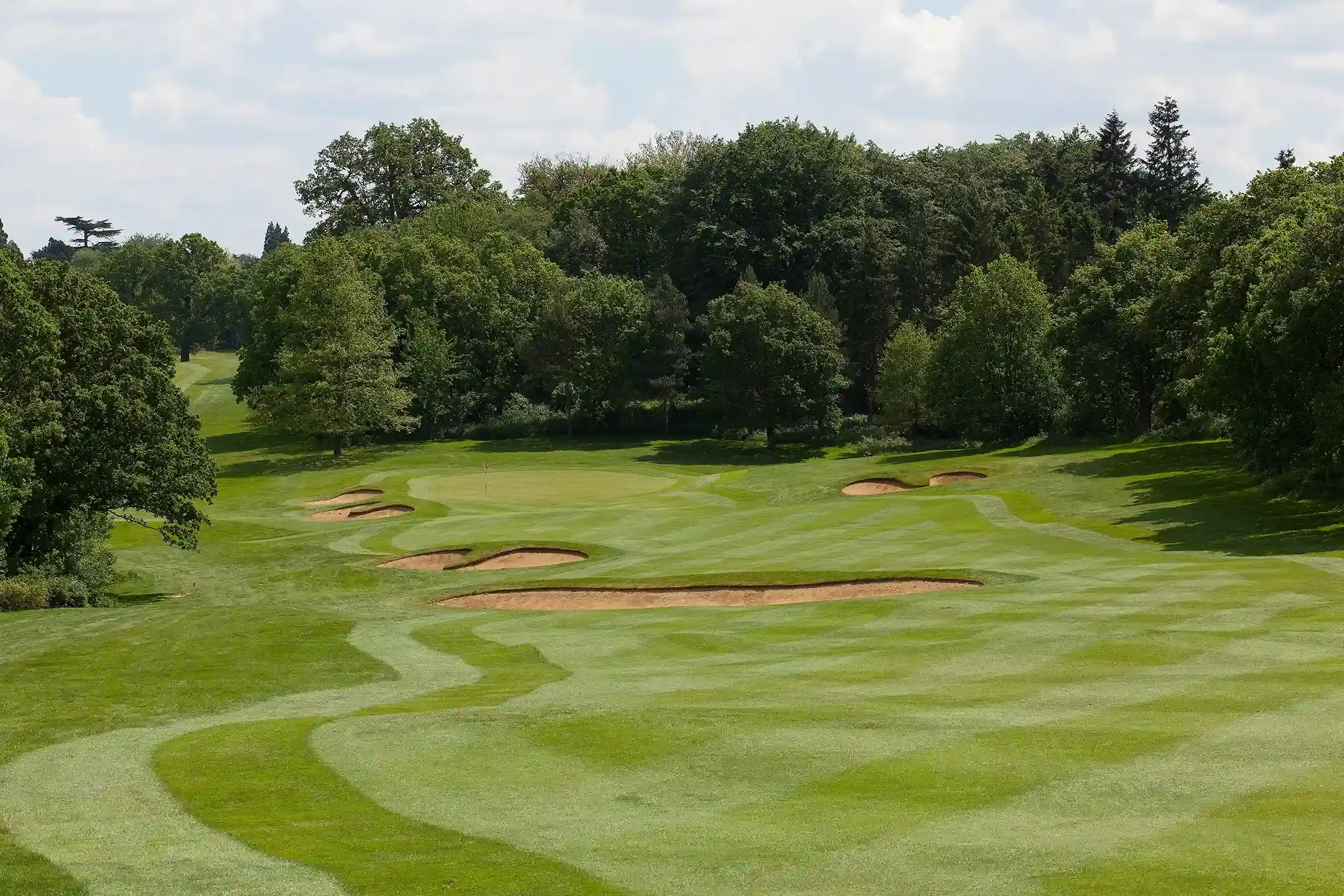
The eighth is a standout par four from any tee. The drive is downhill and inviting, tempting long hitters to attack a fairway that narrows as it climbs back uphill on the approach. A pond guards the approach to a sloping green, and bunkers flank the fairway on the way in. The elevation changes and strategic hazards combine to make this a hole where the tee shot must be thoughtful as well as powerful: too aggressive, and the narrow approach leaves an awkward angle over the water; too cautious, and the distance back up the hill makes the green a very long second shot.
Hole 12 — par 3, 207 yards
Regarded by many as one of the finest inland par threes in England. At 207 yards it demands a mid-iron or long iron under pressure, carrying over a deep valley to a well-guarded green. Bunkers ring the putting surface, the slopes ready to funnel any slightly off-line shot away from the flag, and the scenic backdrop of trees and bracken makes the hole as visually memorable as it is demanding. In tournament play this hole has been the decisive moment in many a competition, a genuine test of nerve and precision in one.
Hole 14 — par 4, 453 yards
The fourteenth is a formidable hole featuring the gully that has been a talking point at Moor Park for generations. The tee shot must find a specific landing area — miss the fairway and the recovery is difficult; hit it right and the approach is complicated by the gully that cuts across the fairway, requiring a carry to a green surrounded by bunkers. Colt’s design here is at its most strategically layered: the hole presents a risk-reward decision on the tee, a precision requirement on the approach, and a challenging putting surface to finish. It is, in the truest sense, a thinking player’s hole.
Why play Moor Park High Course
Moor Park High Course offers a combination of factors that is genuinely exceptional: a Harry Colt design of the highest class, a championship history spanning a century, a setting of extraordinary beauty anchored by a 17th-century mansion, and a standard of course presentation that reflects the club’s ambitions. Visiting golfers will find a layout that tests every department of the game while remaining fair — Colt’s philosophy was always that a good shot should be rewarded and a poor one punished proportionately, and the High Course embodies that principle throughout. The opportunity to play a course that has hosted the Women’s British Open and the Carris Trophy, in surroundings that most English golf clubs can only dream of, makes this a round that stays with golfers long after the scorecard is signed.
Clubhouse and facilities
The clubhouse at Moor Park is the 17th-century mansion itself — one of the most remarkable settings for a golf club in England. The interior is as impressive as the exterior, with spacious changing rooms, a well-appointed pro shop, and clubhouse dining in rooms of genuine historic character. Tuition is available from the club’s professional staff, and practice facilities include a driving range and putting green. Buggy hire is available subject to conditions, and trolleys can be hired from the pro shop. The club also has a spa (Qi Spa) and tennis courts, making Moor Park a genuinely multi-sport destination that extends well beyond golf.
Green fees and booking
Moor Park is a private members’ club that welcomes visitors on specified days, subject to availability. Green fees for the High Course reflect the exceptional quality and prestige of the layout, with rates varying by season and tee time. A handicap certificate is typically required, and smart attire is mandatory. For current green fees and tee times, check the official website.
Getting there and parking
Moor Park is well located for visitors from London and the wider south-east, sitting just north-west of the M25.
- By car: Leave the M25 at Junction 17 (A404 Rickmansworth) and follow signs to Moor Park. The club entrance is on Sandy Lodge Lane. Note: use postcode WD3 1QL for sat-nav devices rather than the postal code WD3 1QN.
- By public transport: Moor Park Underground station (Metropolitan line) is within walking distance of the club, providing a direct connection from central London. Journey time from Baker Street is approximately 35 minutes.
- Address and parking: Rickmansworth, Hertfordshire, WD3 1QN. Extensive free parking is available within the grounds.
Where to stay
Rickmansworth and the surrounding area offer a range of accommodation options, with Watford and St Albans providing more extensive choices for those seeking a wider selection.
- Rickmansworth: Several guest houses and hotels are available in the town itself, within a short drive of the course, making early morning tee times straightforward to reach.
- Watford: Five miles from Moor Park, Watford has a broader range of hotels at various price points, with good transport links including Metropolitan line connections.
- St Albans: Around eight miles from the course, St Albans offers characterful hotels and B&Bs in an attractive historic city setting, well connected to Moor Park by road.
What to pack / gear
Smart golf attire is required at Moor Park: collared shirts, tailored trousers or shorts, and soft-spike golf shoes. Metal spikes are not permitted. Denim and trainers are not acceptable. The course is set in parkland that can be exposed on some holes, so a waterproof jacket is advisable year-round. The 7,036-yard layout rewards accurate iron play, so golfers who are between clubs should err on the side of more rather than less — particularly on the demanding par-three 12th. The pro shop is well stocked if any clothing or equipment is needed on arrival.
Nearby attractions
| Attraction | Appeal | Distance |
| Chorleywood Common | Ancient woodland common with walking trails and wildlife | Approx. 2 miles |
| Cassiobury Park, Watford | Large public parkland with River Gade walks and nature reserve | Approx. 4 miles |
| Verulamium Museum, St Albans | Roman Britain museum on the site of Verulamium, with mosaic floors | Approx. 8 miles |
| Hatfield House | Jacobean mansion with formal gardens and extensive parkland | Approx. 12 miles |
| Chiltern Open Air Museum | Collection of rescued historic buildings in a countryside setting | Approx. 5 miles |
Conclusion
Moor Park High Course is among the great inland parkland experiences in English golf: a Harry Colt masterpiece of 1923, set beside an extraordinary 17th-century mansion, with a century of championship history and a standard of presentation that justifies its enduring reputation.
Frequently asked questions
Can visitors play the Moor Park High Course?
Yes, Moor Park High Course is open to visitors on specified days, but as a private members’ club the tee sheet gives priority to members. Visitors are welcomed subject to advance booking and availability, and a handicap certificate is typically required. The club’s official website is the best source of current visitor availability and any specific requirements. It is strongly recommended to book well in advance, particularly for peak weekend visits, and to confirm the dress code requirements at the time of booking. Visiting golfers are expected to adhere to the same standards of conduct and presentation as members during their round.
What makes Harry Colt’s design at Moor Park exceptional?
Harry Colt was one of the most celebrated golf course architects of the early 20th century, and Moor Park High Course is considered one of his finest works. Colt’s distinguishing characteristic was the ability to route courses that appear to grow naturally from the landscape — at Moor Park, the holes thread through woodland and across parkland in a sequence that feels inevitable rather than imposed. His strategic use of bunkering — placed to punish the careless but reward the well-judged shot — remains evident today, and his use of natural terrain features such as the gully on the 14th shows an architect at the height of his powers. The course has been maintained and respected rather than extensively remodelled, which means Colt’s original intentions remain legible across all 18 holes.
How difficult is the High Course?
The High Course is a genuine championship test. Its combination of length (7,036 yards from the blue tees), strategic bunkering, contoured greens, and terrain variation make scoring here a serious undertaking for golfers of any ability. The course rating and slope rating reflect its difficulty honestly, and the layout has hosted professional and elite amateur competition precisely because it examines every aspect of the game without offering easy relief holes. That said, the course is fair: good shots are rewarded and poor ones punished proportionately, in the classic Colt tradition. Golfers who enjoy thinking their way around a course, and who have the ball-striking to back up their strategy, will find the High Course one of the most satisfying rounds available in England.
Is there accommodation at Moor Park?
Moor Park Golf Club does not operate a hotel on site, but the surrounding Hertfordshire area offers a variety of accommodation options within easy reach of the course. Rickmansworth itself has guest houses, and Watford — approximately five miles away — has a broader range of hotels. The Metropolitan Underground line connection from Moor Park station also makes staying in central London a feasible option for those happy to commute to the course. The club’s official website may list recommended local accommodation options for visiting golfers, and early booking is advisable during peak golfing season.
Holyhead Golf Club
Holyhead Golf Club (Holyhead, Isle of Anglesey, Wales) Nestled on the ruggedly beautiful Isle of Anglesey in Wales, Holyhead Golf Club offers an unforgettable golfing experience that combines history, challenge, and breathtaking scenery. Imagine standing on the tee,...
Rolls of Monmouth Golf Club
Rolls of Monmouth Golf Club (Monmouth, Monmouthshire, Wales) Nestled in the heart of Monmouth, Monmouthshire, Wales, the Rolls of Monmouth Golf Club is a hidden gem that offers an unparalleled golfing experience amidst breathtaking natural beauty. Imagine teeing off...
The Celtic Manor Resort – Roman Road Course
The Celtic Manor Resort - Roman Road Course (Newport, Newport, Wales) Nestled in the picturesque Usk Valley, The Roman Road Course at Celtic Manor Resort offers golfers a journey through history and natural beauty. As you stand on the tee, overlooking the Severn...

North Wales Golf Club
North Wales Golf Club (Llandudno, Conwy, Wales) Nestled on the West Shore of Llandudno, the North Wales Golf Club offers a true championship links experience with breathtaking views over the Conwy estuary towards Anglesey and the majestic Snowdonia mountains....
Machynys Peninsula Golf Club
Machynys Peninsula Golf Club (Llanelli, Carmarthenshire, Wales) Nestled on the edge of Carmarthen Bay, Machynys Peninsula Golf Club is a jewel in Welsh golf, offering an unforgettable experience for players of all abilities. Designed by the legendary Jack Nicklaus and...