
Coxmoor Golf Club
Coxmoor Golf Club — championship heathland golf above Sutton-in-Ashfield
Stand on the high ground at Coxmoor and Nottinghamshire rolls away beneath you, the fairways threading through heather and gorse on a sandy plateau that has hosted golf for more than a century. Coxmoor Golf Club sits on Coxmoor Road just outside Sutton-in-Ashfield, Nottinghamshire, a heathland course of 6,822 yards from the black tees playing to a par of 73. Accredited by England Golf as a Championship Venue, it has staged Open Championship qualifying, the British Boys Championship and the British Seniors Championship.
This is a club with genuine pedigree: the course was shaped by Tom Williamson of Hollinwell with club professional Len White, and it remains the home club of Ryder Cup player Oliver Wilson. If you want classic English heathland golf without the crowds, Coxmoor belongs firmly on your list.
Key Details
- Location: Coxmoor Road, Sutton-in-Ashfield, Nottinghamshire, England
- Length: 6,822 yards (black tees)
- Par: 73 (five par fives, four par threes)
- Designers: Tom Williamson and Len White
- Established: 1913
- Notable Events: Open Championship qualifying; British Boys Championship (won by Matt Fitzpatrick); British Seniors Championship
History and significance
Coxmoor Golf Club was founded in 1913, when a group of Sutton-in-Ashfield enthusiasts, led by the Rev T. G. Shelmerdine, resolved to bring golf to the town. A nine-hole course was laid out on virgin heathland west of the present clubhouse, with play beginning the following spring. Len White, the club’s first professional, doubled as greenkeeper and steward in those pioneering years.
By the late 1920s the club had outgrown nine holes, and a second nine — designed by Tom Williamson, the celebrated professional at nearby Hollinwell, together with Len White — opened the course to a full eighteen in 1929. Williamson later returned to plan a completely new eighteen-hole layout, again built with White, and it is this vision that forms the foundations of the course you play today.
Coxmoor’s honours board is remarkable for a members’ club. Alec Shepperson, developed at Coxmoor, played in two Walker Cups for Great Britain. Greg Owen went from the junior ranks here to the professional tours, and Oliver Wilson — Ryder Cup player and DP World Tour winner — remains a proud member who has contributed to the course’s ongoing redevelopment alongside architects Ken Moodie and Ken Brown.
The club has hosted Open Championship qualifying, the British Boys Championship — won at Coxmoor by future major champion Matt Fitzpatrick — and the British Seniors Championship, and is widely counted among Nottinghamshire’s leading courses alongside Hollinwell, Sherwood Forest and Worksop.
The course and how it plays
Coxmoor is heathland golf in its purest form: sandy, pebbly ground, heather and gorse framing the fairways, and greens that members and visitors consistently describe as among the truest in the county. The land sits at roughly 500 to 600 feet above sea level, among the highest golfing ground in Nottinghamshire, so the wind is a constant companion and club selection matters on every hole.
The par of 73 comes from an unusual and enjoyable balance: five par fives, four par threes and nine par fours. The card reads 3,311 yards out and 3,511 yards home from the black tees, so the finish asks the bigger questions. The opening hole is a stern 437-yard par four, the 12th — 401 yards and stroke index one — is the hardest hole on the course, and the 16th stretches to 579 yards, the longest of the five three-shotters.
Four sets of tees (black, white, yellow and red) let you pick your battle: 6,738 yards from the whites, 6,275 from the yellows and 5,637 from the reds, where the course plays as a par 74. Whatever the markers, the recipe is the same — drive it straight, respect the heather, and trust the putting surfaces.
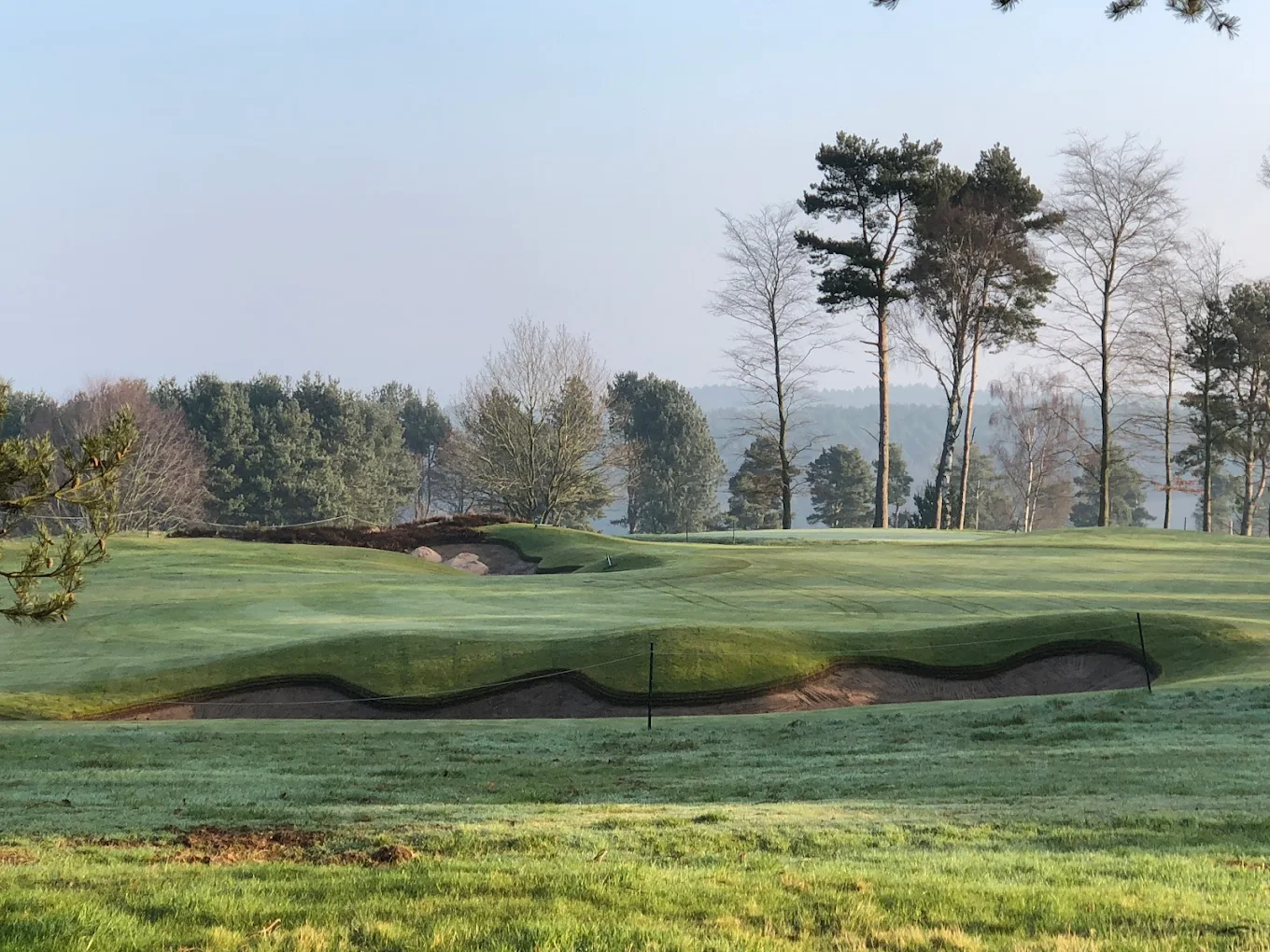
Signature holes
Coxmoor’s variety is its calling card — visitors often remark that no two holes feel alike. These are the holes, verified against the club’s official scorecard, that tend to linger in the memory.
Hole 1 — par 4, 437 yards
There is no gentle handshake here. The opener is one of the longest two-shotters on the course and stroke index four, demanding a confident drive between the heather before a long approach. Walk off with a par and you have beaten the card’s expectations from the very first swing.
Hole 12 — par 4, 401 yards
Stroke index one, and it earns the ranking. At 401 yards the 12th is not the longest par four at Coxmoor, but position from the tee is everything, and the exposed high ground means the wind usually has a say. A four here feels like a birdie.
Hole 13 — par 5, 535 yards
The 13th runs out towards Sherwood Observatory, whose dome makes one of the more unusual backdrops in English golf — the observatory land borders the course. A genuine three-shot hole for most, it rewards patient placement rather than heroics, and the stroke index of 17 tempts you into chasing a score.
Hole 18 — par 5, 550 yards
Coxmoor closes with a 550-yard par five, the second of back-to-back three-shotters at 16 and 18 sandwiching a 194-yard short hole. It is a finish that can rescue a card or wreck one, and it sends you back to the clubhouse already plotting the return visit.
Why play Coxmoor Golf Club
Because it offers championship-accredited heathland golf with a genuine welcome. The course has tested Open qualifiers and the best boys and seniors in Britain, yet visitors are embraced rather than tolerated — the club’s friendly service is a recurring theme in reviews, and one visitor called it “one of the best courses I have ever played in the UK — great test of golf, every hole is different”.
There is also the pull of pedigree. You are walking fairways designed by Tom Williamson, shaped by a century of care, and still being refined today with input from Ryder Cup player Oliver Wilson and architects Ken Moodie and Ken Brown. Add the fast, true greens and that rare par-73 rhythm of five par fives, and Coxmoor makes a persuasive case as one of the East Midlands’ most rewarding days of golf.
Clubhouse and facilities
The clubhouse is warm and well run, with dining that draws consistent praise — visitor packages often bundle breakfast rolls and a hearty meal around the golf, and the catering team looks after societies and corporate days. It is a comfortable place to settle after your round and relive the card, hole by hole.
The professional’s team runs a well-stocked golf shop and offers lessons for every standard, from beginners to low handicappers. The course itself is superbly maintained year-round, and the club publishes a dress code for visitors — smart golf attire is expected, so check before you travel.
Green fees and booking
Coxmoor publishes seasonal visitor rates on its official website, typically from around £80 in the early and late season to about £120 at the height of summer, with a reduced weekday winter package that includes catering. Multi-round weekday rates are available in summer, and larger societies are looked after by the club office.
For current green fees and tee times, check the official website.
Getting there and parking
Coxmoor sits between Sutton-in-Ashfield and Nottingham, close to the M1, and is straightforward to reach from across the East Midlands.
- By car: Leave the M1 at Junction 28 and follow signs for Sutton-in-Ashfield; the club lies on Coxmoor Road, south-east of the town and south of Mansfield.
- By public transport: The Robin Hood Line (East Midlands Railway) between Nottingham and Mansfield serves Sutton Parkway, the nearest station to the course; local buses link Sutton-in-Ashfield with Mansfield and Nottingham.
- Address & parking: Coxmoor Golf Club, Coxmoor Road, Sutton-in-Ashfield, Nottinghamshire, NG17 5LF. On-site parking is available for visitors.
Where to stay
Sutton-in-Ashfield and neighbouring Mansfield make the most convenient bases, with familiar chain hotels and guesthouses within a short drive of the course — the club’s own website lists recommended accommodation nearby. For a livelier stay, Nottingham is around half an hour away by car or train, offering city-centre hotels, restaurants and plenty to fill a non-golfing evening.
If you are building a golfing itinerary around Nottinghamshire’s heathland belt, staying between Sutton-in-Ashfield and Mansfield puts Coxmoor, Hollinwell and Sherwood Forest all within easy reach.
What to pack
Coxmoor’s elevated, exposed setting means conditions change quickly, so pack layers and a windproof top even in summer. Bring a waterproof suit, an umbrella, and a few extra balls for the heather — it is beautiful to look at and less forgiving to play from. Smart golf attire is required, so leave the denim and trainers at home, and sun cream and a cap earn their place on clear days up on the plateau.
Nearby attractions
Nottinghamshire packs legend, history and landscape into a small area, and several of its best days out sit within an easy drive of the course.
| Attraction | Appeal | Distance |
| Sherwood Observatory | Planetarium and science discovery centre bordering the course | 0.5 miles |
| Newstead Abbey | Lord Byron’s ancestral home, gardens and parkland | 8 miles |
| Sherwood Forest | Ancient oaks and Robin Hood country walking trails | 10 miles |
| Hardwick Hall | Elizabethan mansion and gardens (National Trust) | 12 miles |
| Nottingham Castle | Historic site, museum and city views | 15 miles |
| Clumber Park | National Trust parkland, lake and cycling paths | 20 miles |
Conclusion
Coxmoor Golf Club is Nottinghamshire heathland golf at its best — a century-old championship venue with fast greens, honest challenges and a welcome as warm as any in the county. Play it once and you will understand why its members never leave.
Frequently asked questions
How long is the course at Coxmoor Golf Club and what is the par?
From the back (black) tees Coxmoor measures 6,822 yards and plays to a par of 73, made up of five par fives, four par threes and nine par fours. The nines are noticeably different in length — 3,311 yards out and 3,511 yards home — so the round builds towards a demanding finish that includes the 579-yard 16th and the 550-yard 18th. Three further sets of tees give plenty of flexibility: the whites play 6,738 yards, the yellows 6,275 yards, and the red tees measure 5,637 yards as a par 74. The stroke index one hole is the 401-yard 12th, while the shortest hole on the card is the 140-yard 7th.
Who designed Coxmoor Golf Club and when was it founded?
The club was founded in 1913 and began with nine holes on heathland outside Sutton-in-Ashfield, with play starting the following spring. As membership grew, a second nine designed by Tom Williamson — the famous professional at neighbouring Hollinwell — and Coxmoor’s own professional Len White brought the course to eighteen holes in 1929. Williamson later returned to lay out a completely new eighteen-hole course, again built with White, and that design forms the basis of today’s layout. More recently the course has been sympathetically redeveloped with input from golf course architects Ken Moodie and Ken Brown, working alongside Coxmoor member and Ryder Cup player Oliver Wilson.
Has Coxmoor Golf Club hosted major championships?
Yes. Coxmoor is accredited by England Golf as a Championship Venue and has an impressive tournament record for a members’ club. It has served as an Open Championship qualifying course, and it staged the British Boys Championship, which was won at Coxmoor by Matt Fitzpatrick, who went on to become a major champion. The club has also hosted the British Seniors Championship. Beyond tournaments, the club’s playing pedigree runs deep: Walker Cup golfer Alec Shepperson learned his game here, and tour professionals Greg Owen and Oliver Wilson both came through the Coxmoor junior ranks.
How much are green fees at Coxmoor Golf Club?
Visitor green fees are seasonal and published on the club’s official website. As a guide, rates typically run from around £80 in the early and late season up to about £120 per round at the height of summer, with a weekday winter package at a reduced price that includes catering before and after the round. Discounted multi-round weekday rates are offered in the summer months, and visiting societies and larger groups are handled by the club office, which can arrange catering and competition formats. Prices and availability change, so for current green fees and tee times, check the official website before you travel.
Is Coxmoor Golf Club suitable for higher-handicap golfers?
Coxmoor is a championship test, but it is far from unwelcoming for the improving golfer. Four sets of tees mean you can shorten the course considerably — the yellows play 6,275 yards and the reds 5,637 yards as a par 74 — and the five par fives offer realistic scoring chances if you plot your way along them rather than chasing distance. The main defences are heather, wind and well-protected greens, so straight hitting counts for more than raw power. The club’s professionals offer lessons if you fancy sharpening up beforehand, and the friendly atmosphere makes it an encouraging place to test yourself.
How do I get to Coxmoor Golf Club?
The club is at Coxmoor Road, Sutton-in-Ashfield, Nottinghamshire, NG17 5LF, on high ground south of Mansfield and north of Nottingham. Drivers should leave the M1 at Junction 28 and follow signs for Sutton-in-Ashfield; the club is well positioned for anyone travelling through the East Midlands, and on-site parking is available. By rail, the Robin Hood Line between Nottingham, Mansfield and Worksop serves Sutton Parkway, the closest station to the course, with onward taxi or bus connections. Local bus services also link Sutton-in-Ashfield with Mansfield and Nottingham. Allow extra time on competition days, and check the club website for any course or clubhouse notices.
Neath Golf Club
Neath Golf Club (Neath, Neath Port Talbot, Wales) Nestled high above the picturesque Neath Valley, Neath Golf Club offers a golfing experience that is as visually stunning as it is challenging. Designed by the legendary James Braid, this heathland course provides a...
Delta Hotels Marriott St Pierre Country Club
Delta Hotels Marriott St. Pierre Country Club (Chepstow, Monmouthshire, Wales) Nestled in the heart of Chepstow, Monmouthshire, Wales, the Marriott St Pierre Hotel and Country Club is a golfer’s paradise steeped in history. Set within 400 acres of rolling parkland,...

Llandrindod Wells Golf Club
Llandrindod Wells Golf Club (Llandrindod Wells, Powys, Wales) Nestled in the heart of the Welsh countryside, Llandrindod Wells Golf Club offers a golfing experience that is as much about the journey as it is about the destination. Perched on a gently undulating...

Welshpool Golf Club
Welshpool Golf Club (Welshpool, Powys, Wales) Perched atop Golfa Hill, Welshpool Golf Club is a hidden gem that promises an unforgettable golfing experience. This James Braid-designed, 18-hole course in Welshpool, Powys, Wales, captivates with its breathtaking views...

Bull Bay Golf Club
Bull Bay Golf Club (Amlwch, Isle of Anglesey, Wales) Bull Bay Golf Club, nestled on the northern coast of Anglesey, Wales, is a hidden gem that captivates golfers with its dramatic coastal setting and rich history. Imagine standing on an elevated tee, the Irish Sea...