
Royal Portrush Golf Club
Royal Portrush Golf Club— links golf on the edge of the Atlantic
Stand on the first tee at Royal Portrush and the drama is immediate: the Atlantic breaking below, the dunes of the Causeway Coast rolling away, and the ruins of Dunluce Castle brooding on the cliffs in the distance. This is one of the great links experiences in the game — wild, windswept and utterly unforgettable.
Royal Portrush Golf Club’s Dunluce Links is a championship links in Portrush, County Antrim, laid out through the dunes of Northern Ireland’s Causeway Coast. Designed by Harry Colt and reworked by Martin Ebert, it plays to a par of 71 and about 7,381 yards from the championship tees, and it is the only venue outside Great Britain to host The Open Championship — most recently in 2019 and 2025. Founded in 1888, it is regularly ranked among the finest courses in the world.
Key Details
- Location: Portrush, County Antrim, Northern Ireland
- Length: 7,381 yards (championship tees)
- Par: 71 (championship setup)
- Designers: Harry Colt (1933), with a major redesign by Martin Ebert (2015)
- Established: 1888
- Notable Events: The Open Championship (1951, 2019, 2025), Irish Open (2012)
History and significance
Royal Portrush was founded in 1888, originally as the County Club, by a group led by the Scots George L. Baillie and Thomas Gilroy. Old Tom Morris extended the links to eighteen holes in 1889, and in 1895 the club received royal patronage to become Royal Portrush. That same year it staged Ireland’s first professional golf tournament, an early sign of the standing it would come to hold.
The Dunluce Links takes its name from the nearby 13th-century castle ruins. Harry Colt’s 1933 redesign shaped the championship course that made the club’s name, famed for its subtle, running greens. Ahead of the 2019 Open, architect Martin Ebert led a major reworking from 2015: five new greens, eight new tees, ten new bunkers, and two brand-new holes — the 7th and 8th — built on ground borrowed from the club’s Valley Links.
Royal Portrush holds a unique place in the game as the only venue outside Great Britain to host The Open Championship. Max Faulkner won the first, in 1951, when only two players broke 70 all week. The Open returned in 2019 to a vast home crowd, where Shane Lowry ran away to a six-shot victory sealed by a course-record 63. It came back again in 2025, when Scottie Scheffler won by four shots from Harris English. The club also staged the Irish Open in 2012, the first held in Northern Ireland for decades. Local heroes run deep here too: Rory McIlroy famously shot 61 around the old layout as a teenager, and 2011 Open champion Darren Clarke calls Portrush home.
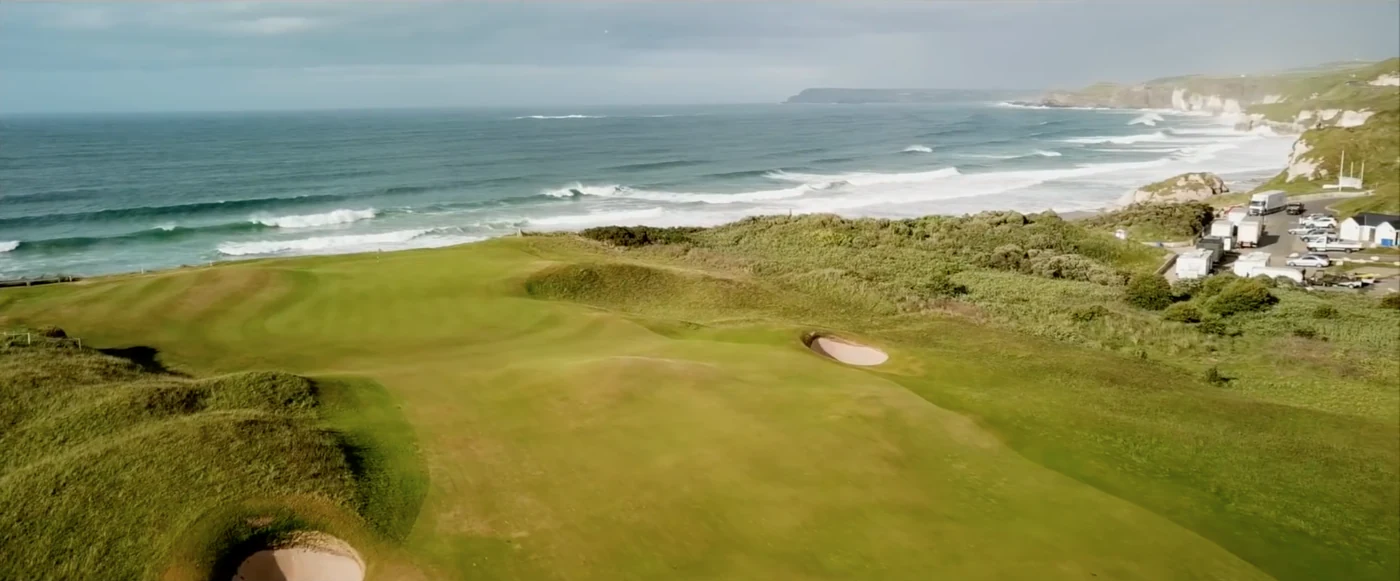
Photos: header image via Google Business Profile; 5th-hole image by The Average Golfer (CC BY 3.0)
The course and how it plays
The Dunluce is a quintessential coastal links, threading through towering dunes along the Antrim coast with the sea in view from almost every hole. Undulating fairways, deep bunkers and fast, sloping greens demand precision, and the wind off the Atlantic can change a hole’s character from one round to the next.
Colt’s greens — preserved and rebuilt through the Ebert work — are among the most admired in golf, full of subtle borrows that test the steadiest putter. Tight fairways and thick rough put a premium on accuracy and course management: this is a links that rewards the thoughtful player and punishes the wayward one.
Signature holes
Royal Portrush is a course of memorable holes, but three stand out.
Hole 5 (White Rocks)
A short par four of around 372 yards, White Rocks is a dogleg that plays downhill towards a green perched on the very edge of the Atlantic. It tempts big hitters to take on the corner, but overcook the shot and the ocean waits below — beauty and danger in equal measure.
Hole 7 (Curran Point)
Introduced for the 2019 Open, this brawny par five of about 607 yards climbs through the dunes and is guarded by the enormous “Wee Nellie” bunker — a nod to the original “Big Nellie”. It rewards bold, well-placed golf and punishes the careless, a modern hole that already feels part of the furniture.
Hole 16 (Calamity Corner)
One of the most feared par threes in golf, “Calamity” plays around 236 yards across a yawning chasm that falls away to the right of the green. There are no bunkers — none are needed. The bail-out left, known as “Locke’s Hollow” after Bobby Locke’s cautious line in 1951, is the sane play; anything right is disaster.
Why play Royal Portrush
Playing the Dunluce is a pilgrimage to one of golf’s true cathedrals. You walk fairways where Shane Lowry lifted the Claret Jug and Scottie Scheffler claimed The Open, on a links that demands every club in the bag and rewards courage and imagination. Add the setting — the Atlantic, the dunes, the ruins of Dunluce Castle on the skyline — and it is an experience that lingers long after the final putt.
Clubhouse and facilities
The clubhouse is a warm, traditional base, with a dining room looking out over the course and coast and the more formal Babington Room for a proper meal. A well-stocked pro shop carries the leading brands, and a halfway house offers refreshments mid-round. Practice facilities are excellent — a driving range, short-game greens and a putting green built to mirror the Dunluce’s own contours, plus a swing-analysis studio. Experienced caddies are available and bring the local knowledge these dunes reward.
Green fees and booking
The Dunluce Links, host of the 2019 and 2025 Open Championships, is Royal Portrush’s flagship course and one of the most in-demand tee times in the game. A visitor round is typically around £420 in the main season from April to October, with lower rates in the quieter months and a Golf Ireland rate for four-balls available on request.
Green fees are payable in full on booking, visitors are asked to be members of recognised clubs, and handicap certificates may be requested, so book well in advance. For current green fees and tee times, check the official website.
Getting there and parking
Royal Portrush is on the Causeway Coast, about 67 miles north of Belfast.
- By car: from Belfast take the M2, then the A26 to Coleraine and the A29 into Portrush; the club sits on the A2 (Dunluce Road), a short distance from the town centre.
- By public transport: Translink trains run to Portrush station, a short taxi ride from the club.
- Address & parking: Dunluce Road, Portrush, County Antrim, BT56 8JQ, with ample on-site parking.
Where to stay
Portrush itself is the natural base, a lively seaside resort right beside the course. A few options, depending on your trip:
- In Portrush: a good range of hotels, guesthouses and B&Bs within a few minutes of the first tee, many with sea views.
- Along the Causeway Coast: nearby Portstewart is an easy, characterful alternative if you want to explore the coast.
- For a wider trip: Coleraine or Belfast (about an hour and a quarter away) work as bigger-town bases if you are pairing several courses.
Book well ahead, especially in summer and around any championship, when the whole coast fills quickly.
What to pack
This is exposed Atlantic links golf, so pack for wind and sudden weather whatever the forecast:
- Waterproof jacket and trousers, plus a windproof mid-layer
- A warm layer and a hat for the coastal breeze
- Spare gloves and plenty of extra balls for the dunes and rough
- Sturdy, well-fitting golf shoes for firm, undulating links turf
- Sunscreen — the light off the sea catches you out even on cool days
Nearby attractions
The Causeway Coast is one of the most spectacular corners of the British Isles, and there is plenty to see within a short drive.
| Attraction | Appeal | Distance |
|---|---|---|
| Giant’s Causeway | UNESCO World Heritage site of 40,000 basalt columns, with trails and a visitor centre | ~15 min |
| Dunluce Castle | Dramatic 13th-century clifftop ruins overlooking the course | ~5 min |
| Carrick-a-Rede Rope Bridge | Thrilling clifftop rope bridge with sweeping coastal views | ~30 min |
| Mussenden Temple & Downhill Demesne | Clifftop temple and estate with panoramic Atlantic views | ~20 min |
| Portstewart Strand | Two-mile golden beach for coastal walks and water sports | ~10 min |
Conclusion
Few courses fuse golf, history and landscape like Royal Portrush. Whether you are chasing par at Calamity or simply savouring the Atlantic view from White Rocks, the Dunluce delivers a round you will replay in your mind for years. Come once, and you will already be planning the trip back.
Frequently asked questions
When was Royal Portrush Golf Club established?
Royal Portrush was founded in 1888, originally as the County Club, before Old Tom Morris extended it to eighteen holes in 1889. It received royal patronage in 1895, becoming Royal Portrush Golf Club, and staged Ireland’s first professional tournament that same year. The Dunluce Links was reshaped by Harry Colt in 1933 and given a major modern redesign by Martin Ebert from 2015 ahead of the 2019 Open, making it a course with well over a century of championship heritage behind it.
What is the Dunluce Links’ par and length?
For championship play the Dunluce Links is a par 71 measuring about 7,381 yards from the back tees, as set up for The Open in 2025. From the forward tees it plays considerably shorter, so golfers of all standards can enjoy it while soaking up the coastal scenery. It is a demanding test — exposed to the Atlantic wind, with tight fairways, deep bunkers and Harry Colt’s famously subtle greens all putting a premium on accuracy and clever course management.
Who designed Royal Portrush?
The Dunluce Links owes its championship character to Harry Colt, whose 1933 redesign created the course that made Royal Portrush’s name, celebrated above all for its greens. Old Tom Morris had earlier extended the original links to eighteen holes in 1889. Most recently, architect Martin Ebert led a major redesign from 2015 for the 2019 Open, adding five new greens, eight new tees, ten new bunkers and two entirely new holes — the 7th and 8th — on land taken in from the club’s Valley Links.
What are the most famous holes at Royal Portrush?
The most celebrated is the 16th, “Calamity Corner”, a par three of around 236 yards played across a deep chasm with no bunkers needed to defend it. The 5th, “White Rocks”, is a stunning short par four doglegging down to a green on the very edge of the Atlantic. The newest star is the 7th, “Curran Point”, a long par five built for the 2019 Open and guarded by the vast “Wee Nellie” bunker. Together they capture the Dunluce’s blend of beauty, drama and difficulty.
Which championships has Royal Portrush hosted?
Royal Portrush is the only venue outside Great Britain to host The Open Championship, staging it in 1951 (won by Max Faulkner), 2019 (Shane Lowry, with a course-record 63) and 2025 (Scottie Scheffler, by four shots from Harris English). It also hosted the Irish Open in 2012, the first held in Northern Ireland for decades. This championship pedigree, together with its Causeway Coast setting, is a large part of why the course is held in such high regard worldwide.
How do I get to Royal Portrush, and is there parking?
Royal Portrush is on the Causeway Coast, roughly 67 miles north of Belfast. By car, take the M2 and A26 to Coleraine, then the A29 into Portrush; the club is on the A2, Dunluce Road, a short distance from the town centre, with ample on-site parking. By public transport, Translink trains run to Portrush station, from where the club is a short taxi ride. The full address is Dunluce Road, Portrush, County Antrim, BT56 8JQ.
Are there other courses nearby?
Yes. Royal Portrush also has its second course, the Valley Links, right alongside the Dunluce, and Portstewart Golf Club’s Strand Course is only a few minutes away along the coast — both outstanding links in their own right. The wider Causeway Coast and north Antrim area make this one of the great golfing corners of the British Isles, so it is easy to build a multi-course trip around a round on the Dunluce.
Castlereagh Hills Golf Club
Castlereagh Hills — a hidden gem above BelfastClimb to the higher ground at Castlereagh Hills and the reward is immediate: rolling parkland fairways falling away towards the glint of Strangford Lough and the County Down hills beyond. This unassuming municipal course,...
Knock Golf Club
Knock Golf Club — a Colt, Mackenzie and Alison parkland in BelfastBeside the Stormont estate in east Belfast lies a parkland with a pedigree most clubs can only dream of: Knock was laid out by Colt, Mackenzie and Alison, three of the greatest names in golf...
City of Derry Golf Club
City of Derry Golf Club — parkland above the Foyle at PrehenThreading through mature woodland on the wooded slopes at Prehen, high above the River Foyle, City of Derry is the premier parkland course of the north-west. A Willie Park Jr layout with well over a century...
Cliftonville Golf Club
Cliftonville Golf Club — a friendly parkland in north BelfastTucked into north Belfast, Cliftonville is a welcoming nine-and-back parkland that has been part of the city's golfing life since 1911. Compact, well-kept and genuinely friendly, it is the kind of club where...
Rockmount Golf Club
Rockmount Golf Club — a modern championship parkland near BelfastOpened by Darren Clarke and built to championship length, Rockmount is one of the newer stars of golf around Belfast. Set in rolling County Down countryside at Carryduff, it is a spacious,...