
Wildernesse Golf Club
Wildernesse Golf Club — woodland precision in the heart of Kent
Push through the tree line on the first tee and the character of Wildernesse announces itself immediately: fairways threading through mature woodland, light filtering through a canopy of oak and beech, the ground slightly undulating beneath a course that has been played here since 1890. Wildernesse Golf Club occupies a remarkable setting in Seal, near Sevenoaks, its par-72, 6,539-yard layout winding in a clockwise direction around Chance Wood in a sequence that blends natural beauty with genuine strategic challenge. Selected by the R&A as a Regional Qualifying course for The Open Championship, Wildernesse is one of Kent’s most respected private clubs and a course that rewards thoughtful, precise play above all else.
Key Details
- Location: Seal, Sevenoaks, Kent, TN15 0JE
- Length: 6,539 yards (white tees)
- Par: 72
- Designers: Original layout unknown (founded 1890); James Braid (redesign including new 5th hole, 1929); Jonathan Gaunt (improvements, 2013)
- Established: 1890
- Notable Events: R&A Regional Qualifying for The Open Championship (1998–2003 and subsequent seasons); Kent Amateur Championship; England Golf county events
History and significance
Wildernesse Golf Club was founded in 1890, when golf was still finding its feet as a mainstream pursuit in England. Golf had been played informally on the Wildernesse estate even before the formal establishment of the club, which makes this one of the genuinely historic sites in English golf. The original layout was fashioned from the natural woodland landscape, and the course has always played in its distinctive clockwise circuit around Chance Wood — a routing that has remained essentially unchanged through successive generations of improvement.
The most significant early architectural intervention came from James Braid, the five-time Open Champion turned prolific course designer, who in 1929 made a series of alterations including the addition of the par-three 5th hole. Braid’s contribution gave the course sharper definition and a classic strategic quality that set the template for the layout visitors play today. More recent improvements by Jonathan Gaunt in 2013 have refined the course without disturbing its essential character: Wildernesse remains a course of quiet woodland beauty and genuine challenge, valued by its members and admired by visiting golfers who discover it.
The R&A’s selection of Wildernesse as a Regional Qualifying venue for The Open Championship speaks to the consistent quality of the layout and its reputation within the game. Hosting aspirant Open competitors — professionals and elite amateurs battling for scarce qualifying places — places the club in distinguished company and reflects the respect it commands in English golf.
The course and how it plays
Wildernesse presents its challenges quietly rather than dramatically. The fairways are tree-lined and narrow by modern standards, demanding accuracy from the tee above raw distance. Drives that stray into the woodland are either lost or present awkward recovery shots; those that split the fairway leave manageable approaches. The greens are small by contemporary standards — a signature feature of courses from this era — fast and true but with subtle borrows that reward golfers who have taken the trouble to read them carefully. The combination of narrow corridors and small, contoured greens means that scoring is determined by skill rather than power, and the course flatters the thoughtful player over the long hitter.
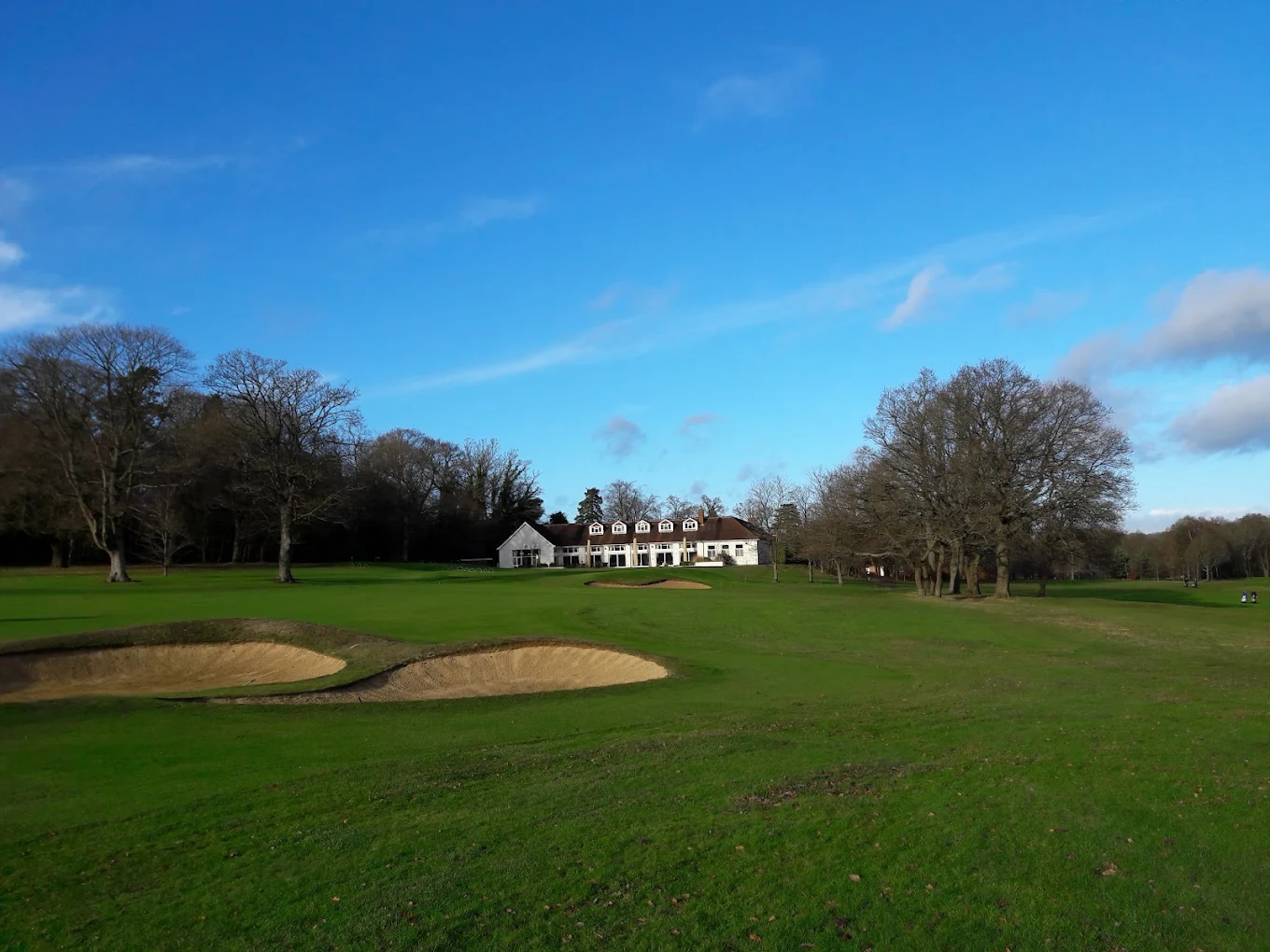
The front nine is a precision-demanding stretch through the lower, more enclosed sections of the estate. The holes feel individual and private, each turn revealing a new corridor of trees and a fresh challenge. The back nine introduces slightly more variety in character, with a more open feel in places before the course tightens again for a memorable three-hole finish. The par-five closing hole is a particular favourite: from an elevated tee, the fairway doglegs through a narrowing corridor of trees before rising to a green positioned in front of the clubhouse, often with spectators watching from the terrace. It is a finishing hole that invites boldness and punishes carelessness in equal measure.
The course plays clockwise throughout its routing around Chance Wood, which means wind direction affects different holes differently depending on the day. This variability adds a layer of complexity on days when the breeze is up — a round in a stiff south-westerly feels quite different from the same holes in calm conditions. Course knowledge built over multiple visits rewards regular visitors significantly.
Signature holes
Three holes illustrate most clearly what makes Wildernesse distinctive.
Hole 2 — par 4, approximately 400 yards
The second hole sets the tone for Wildernesse’s strategic demands. The fairway curves gently right, flanked on the right by a pond that creates an immediate risk-reward decision from the tee. Mature trees narrow the landing area, punishing the pull or the block, and the approach must be precise to hold a well-protected green. The combination of water hazard, trees, and a small target green makes this an early litmus test of a player’s accuracy and composure.
Hole 5 — par 3, 157 yards
James Braid’s contribution to Wildernesse is encapsulated in this gem of a short hole. At 157 yards the distance is deceptive — the tee shot must carry a valley to a small, undulating green ringed by bunkers and set against a backdrop of dense woodland. The green’s subtle slopes mean that even a well-struck shot to the wrong portion of the putting surface can lead to a three-putt. With a stroke index that reflects its difficulty, this hole produces more discussion in the clubhouse than perhaps any other on the course.
Hole 18 — par 5, approximately 500 yards
The closing hole offers drama and the chance for a memorable finish. From an elevated tee, the fairway doglegs right through a narrowing corridor of mature trees before rising uphill to a green perched in front of the clubhouse. Bold driving opens up the possibility of reaching the green in two, but the tightening corridor makes an overly aggressive line from the tee risky. Bunkers and subtle green contours mean the final approach and putt demand as much care as any earlier in the round — a worthy climax to a course of consistent quality.
Why play Wildernesse Golf Club
Wildernesse offers something that is increasingly rare: a course of genuine heritage, set in exceptional natural surroundings, that has been maintained and carefully improved without losing its essential character. Playing here connects golfers to over 130 years of the sport in Kent — a county with a rich golfing tradition — and to a layout that has been good enough for the R&A to use as a qualifier for the world’s oldest major championship. The course demands precision and rewards course management, making it a particular favourite among golfers who enjoy the intellectual dimension of the game as much as the physical. Sevenoaks and the surrounding Kentish countryside provide a beautiful and peaceful setting that makes a day at Wildernesse genuinely restorative as well as competitive.
Clubhouse and facilities
Wildernesse is a private members’ club with the facilities and atmosphere one would expect from an institution of its standing. The clubhouse provides well-appointed changing rooms, a well-stocked pro shop, and a practice area including a driving range. Clubhouse dining is available for visiting golfers, providing a pleasant setting to reflect on the round. Buggy hire is available subject to course conditions. The club enforces a smart casual dress code — collared shirts and tailored trousers or shorts — and visitors are expected to hold a CDH (Central Database of Handicaps) number as evidence of playing ability. The overall atmosphere is one of a club that takes pride in its traditions while remaining welcoming to visiting golfers who respect the standards expected.
Green fees and booking
Wildernesse is a private club and visitors are welcomed on weekdays, subject to availability. Green fees are set at a level that reflects the quality and reputation of the course. For current green fees and tee times, check the official website.
Getting there and parking
Wildernesse Golf Club is conveniently located near Sevenoaks, well served by both road and rail connections from London and the wider south-east.
- By car: From the M25, exit at Junction 5 (A21) and follow signs towards Sevenoaks. The course is situated in Seal, approximately two miles north-east of Sevenoaks town centre. The approach road leads directly to the clubhouse and car park.
- By public transport: Sevenoaks railway station is served by frequent trains from London Bridge and London Charing Cross, with journey times of approximately 25–35 minutes. Taxis from the station to the course take around ten minutes.
- Address and parking: Seal, Sevenoaks, Kent, TN15 0JE. Free car parking is available on site adjacent to the clubhouse.
Where to stay
Sevenoaks is a well-connected market town with a range of accommodation options, making it an excellent base for a visit to Wildernesse and the wider Kent countryside.
- Sevenoaks town centre: Several hotels and guest houses are available within the town, offering easy access to the course and to the area’s many attractions. The town has good transport links for those arriving without a car.
- Tonbridge: About five miles south of Sevenoaks, Tonbridge has a broader range of hotels at various price points, with good road links to Wildernesse for early tee times.
- Brands Hatch area: Several hotels cluster around the well-known circuit at Fawkham, roughly eight miles from Wildernesse, and offer competitive rates in an area with good motorway access.
What to pack / gear
Smart golf attire is required at Wildernesse — collared shirts and tailored trousers or shorts are expected; denim, trainers, and football shirts are not permitted. Soft-spike golf shoes are the standard. The wooded nature of the course means extra golf balls are advisable, as the woodland rough can be unforgiving. A rangefinder or GPS device is useful on a layout where precise distance judgement to small greens is important. Visitors should also carry a waterproof jacket, as the sheltered woodland setting can make weather changes feel sudden.
Nearby attractions
| Attraction | Appeal | Distance |
| Knole House and Park | One of England’s largest historic houses, set in a medieval deer park (National Trust) | Approx. 2 miles |
| Chartwell | Churchill’s family home with gardens and wartime memorabilia (National Trust) | Approx. 5 miles |
| Ightham Mote | Moated medieval manor house in beautiful Kentish countryside (National Trust) | Approx. 4 miles |
| Hever Castle and Gardens | Tudor castle with extensive formal gardens and lake | Approx. 10 miles |
| Emmetts Garden | Hillside garden with panoramic North Downs views (National Trust) | Approx. 3 miles |
Conclusion
Wildernesse Golf Club is one of Kent’s finest courses: a layout of genuine heritage and natural beauty that demands precision, rewards course management, and offers an experience rooted in the long traditions of English golf.
Frequently asked questions
Is Wildernesse Golf Club open to visitors?
Yes, Wildernesse welcomes visitors on weekdays, subject to availability and advance booking. As a private members’ club the course gives priority to members’ tee times, so visitors are strongly advised to book in advance rather than arriving without a reservation. A CDH (Central Database of Handicaps) number is required, as the club asks visitors to demonstrate a playing standard commensurate with the course. The club’s own website is the best source of current visitor booking availability and any specific requirements. Weekends are generally reserved for members, so weekday visits are the norm for guests from outside the membership.
What handicap is required to play Wildernesse?
Wildernesse Golf Club requires visitors to hold a CDH (Central Database of Handicaps) number as evidence of playing experience. The club may also request a handicap certificate on arrival. While there is no published maximum handicap, the course’s narrow tree-lined fairways and small greens make it a genuine challenge for higher handicappers, and the club expects visitors to be competent golfers who are familiar with the etiquette and pace of play expected at a private members’ club. If in doubt about suitability, it is worth contacting the club directly through the official website before making a booking.
What makes the 5th hole special?
The par-three 5th at Wildernesse is one of the most celebrated holes in Kent golf. Designed by James Braid in 1929, it occupies a natural hollow and requires a carry over a valley to a small, undulating green surrounded by bunkers. At 157 yards it appears manageable, but the green’s subtle slopes and the sheltering effect of surrounding trees — which can mask the true wind direction — make club selection genuinely challenging. The hole’s beauty, its design pedigree, and its stroke index position all contribute to its reputation as a defining moment in a round at Wildernesse. Many visitors recall it as the hole that stays with them longest after the round is finished.
Are buggies available at Wildernesse?
Buggy hire is available at Wildernesse Golf Club, subject to availability and course conditions. In wet periods the club may restrict buggy use to protect the fairways, which are an important part of the course’s character and condition. It is worth confirming buggy availability at the time of booking, particularly for those with mobility requirements, to ensure that arrangements can be made in advance. Trolleys — manual and electric — are also available. The course is walkable for those in good health, and walking the layout is the traditional way to experience its woodland setting fully.
Neath Golf Club
Neath Golf Club (Neath, Neath Port Talbot, Wales) Nestled high above the picturesque Neath Valley, Neath Golf Club offers a golfing experience that is as visually stunning as it is challenging. Designed by the legendary James Braid, this heathland course provides a...
Delta Hotels Marriott St Pierre Country Club
Delta Hotels Marriott St. Pierre Country Club (Chepstow, Monmouthshire, Wales) Nestled in the heart of Chepstow, Monmouthshire, Wales, the Marriott St Pierre Hotel and Country Club is a golfer’s paradise steeped in history. Set within 400 acres of rolling parkland,...

Llandrindod Wells Golf Club
Llandrindod Wells Golf Club (Llandrindod Wells, Powys, Wales) Nestled in the heart of the Welsh countryside, Llandrindod Wells Golf Club offers a golfing experience that is as much about the journey as it is about the destination. Perched on a gently undulating...
Welshpool Golf Club
Welshpool Golf Club (Welshpool, Powys, Wales) Perched atop Golfa Hill, Welshpool Golf Club is a hidden gem that promises an unforgettable golfing experience. This James Braid-designed, 18-hole course in Welshpool, Powys, Wales, captivates with its breathtaking views...
Bull Bay Golf Club
Bull Bay Golf Club (Amlwch, Isle of Anglesey, Wales) Bull Bay Golf Club, nestled on the northern coast of Anglesey, Wales, is a hidden gem that captivates golfers with its dramatic coastal setting and rich history. Imagine standing on an elevated tee, the Irish Sea...