
Frilford Heath Golf Club (Red Course)
Frilford Heath Red Course — JH Taylor’s heathland championship in Oxfordshire
Stand on the first tee at Frilford Heath and feel the particular quality of ground beneath your feet: firm, sandy, quick-draining heathland that Bernard Darwin himself described as making for golf that is “both good and difficult.” The Red Course at Frilford Heath Golf Club, designed in 1908 by five-time Open Champion JH Taylor, is one of England’s great heathland tests — a par-72, 7,045-yard layout set across the distinctive sandy heathland ground near Abingdon in Oxfordshire. With pushed-up greens, strategic bunkering, and fast-running fairways, it rewards the traditionalist golfer who understands that accuracy and course management matter more than raw distance. The Red Course has hosted the English Amateur Championship, the Brabazon Trophy, and European Tour Qualifying School events, and it remains one of the most complete and satisfying rounds of heathland golf in the country.
Key Details
- Location: Oxford Road, Frilford, Abingdon, Oxfordshire, OX13 5NW
- Length: 7,045 yards (championship tees)
- Par: 72
- Designers: JH Taylor (original, 1908); modifications by JH Turner (long-serving club professional)
- Established: 1908
- Notable Events: English Amateur Championship; Brabazon Trophy; European Tour First Stage Qualifying School
History and significance
The Red Course was laid out in 1908 by John Henry Taylor — JH Taylor — one of the Great Triumvirate of late Victorian and Edwardian golf alongside Harry Vardon and James Braid. Taylor won the Open Championship five times and brought to his design work the same understanding of strategic play that made him a champion. His instinct was for courses that demanded intelligent play: the pushed-up greens and contoured fairways of the Red Course reflect a design philosophy rooted in the links traditions of the south-west, translated thoughtfully to Oxfordshire’s distinctive sandy heathland.
The course has been lightly modified over the years by JH Turner, a long-serving club professional whose changes were made sympathetically within the spirit of Taylor’s original. In essence the Red Course remains Taylor’s creation, and the restraint shown in leaving it largely intact across more than a century speaks to the enduring quality of the original design. Bernard Darwin’s celebrated verdict — that the course is “both good and difficult” — has proven durable: modern visitors discover that the assessment remains as accurate today as when it was made.
The championship credentials of the Red Course are well established. It has hosted the English Amateur Championship — one of the most prestigious events in the domestic amateur calendar — and the Brabazon Trophy, which is the premier amateur strokeplay championship in England. The European Tour’s Qualifying School has used the course as a testing ground for aspiring professionals. Each of these events confirms what visitors discover: the Red Course is a genuine examination of golf at the highest level.
The course and how it plays
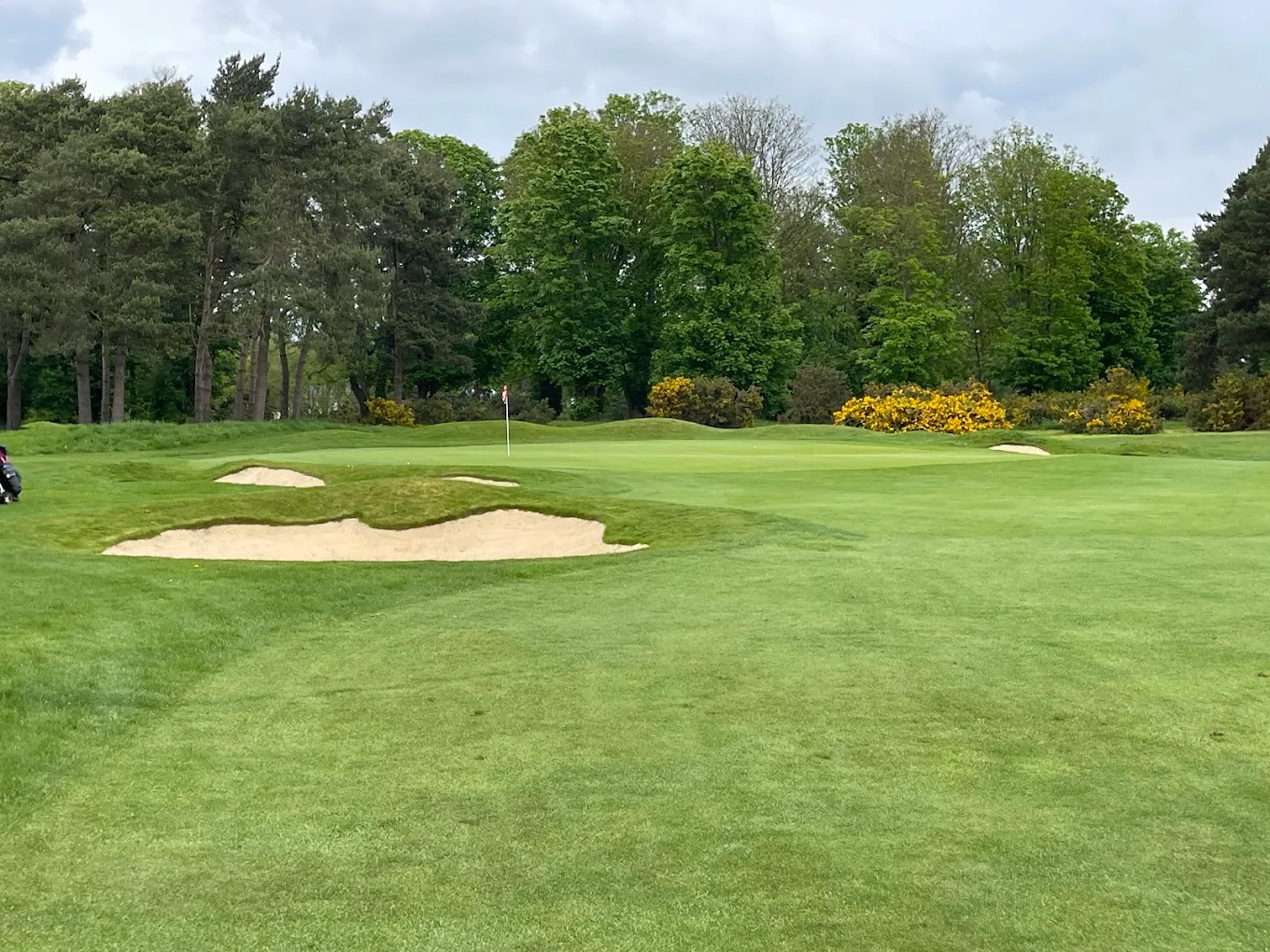
Frilford Heath’s Red Course plays as a proper heathland course should: the ground is firm and fast in dry conditions, the ball runs freely on the fairways, and the greens are pushed up above the surrounding ground level in the traditional manner. These raised greens are a defining feature: they can be held with a well-struck approach but will reject shots that arrive from the wrong angle or with insufficient precision. Miss the green on the wrong side and a simple-looking chip becomes complicated; find the correct portion of the putting surface and birdie opportunities follow.
Gorse is the dominant rough feature and it is unforgiving. The sandy soil grows gorse prolifically, and drives that miss the fairways typically find it — with the consequences that usually attend. Fairways are broad enough to allow controlled aggression from the tee, but the gorse and strategic bunkering ensure that the driver must be used with some discretion. Golfers who work the ball are well rewarded here; those who rely on straight driving and hope find the course a stiffer test.
The routing builds to demanding sequences that test both physical and mental stamina. A stretch of consecutive par fours in the closing holes places particular demands on iron-play consistency. The par-three 9th — requiring a carry over a pond — is the most dramatic moment on the front nine, and the finishing hole provides a proper examination to close the round. The club’s practice facilities are excellent, with a full driving range and short-game area, making it well worth arriving early to prepare for a course that rewards preparation.
Signature holes
Three holes capture the essential character of the Red Course.
Hole 9 — par 3, 188 yards
The ninth is the Red Course’s most talked-about hole. The tee shot must carry a pond short of the green, with out-of-bounds positioned behind — a combination that concentrates the mind wonderfully. There is little margin for error in either direction: too short and the ball finds the water; too long and out-of-bounds beckons. The green has enough slope to make the ball position after the tee shot critical for the putt. It is a hole where boldness and precision must coexist, and the view from the tee — water in the foreground, the raised green beyond — is one of the most striking moments on the course.
Hole 5 — par 4, 455 yards
The fifth launches the demanding central stretch of the Red Course. At 455 yards it requires both length and accuracy: gorse lines the fairway tightly on both sides, and bunkers guard the approach to a well-protected green. A powerful drive to a precise position on the fairway is needed to open up the approach, and even then the second shot demands confidence. The hole exemplifies the Red Course’s central challenge — the need to be assertive off the tee while remaining accurate enough to avoid the flanking gorse and sand.
Hole 18 — par 4, 435 yards
The closing hole is a worthy finish to a demanding round. At 435 yards it is part of a formidable run of par fours through the back nine, and it requires a strategic drive to a fairway that narrows on approach. Bunkers flank the green on both sides, and the pressure of closing a round on a hole of this quality concentrates even experienced golfers wonderfully. A par at the last feels properly earned; a birdie here is a genuine achievement to take away from a memorable round.
Why play Frilford Heath Red Course
Frilford Heath Red Course offers a golfing experience that is increasingly rare: authentic heathland golf as it was conceived over a century ago, on ground perfectly suited to the game, in a condition that reflects considerable investment in both maintenance and practice facilities. JH Taylor’s design has stood the test of time precisely because it is built on sound architectural principles — strategic rather than penal, varied rather than repetitive, and sufficiently demanding to challenge the best without defeating the committed amateur. The combination of championship credentials, an excellent practice facility, and the particular pleasure of playing on firm, fast heathland ground makes Frilford Heath a destination course that rewards the effort of making the journey to Oxfordshire.
Clubhouse and facilities
Frilford Heath’s facilities reflect an ongoing commitment to improvement alongside the preservation of the traditional course character. The clubhouse has well-appointed changing rooms and a well-stocked golf shop with a pair of indoor performance centres for club fitting and technical analysis. Practice facilities are comprehensive: a full driving range with grass teeing bays, a substantial short-game area with practice bunkers, and a large putting green in front of the clubhouse. Clubhouse dining is available for visiting golfers, and function rooms are available for society and group events. The club operates a traditional feel while providing modern facilities, balancing the historic character of the Red Course with the practical needs of contemporary visitors.
Green fees and booking
Green fees at Frilford Heath vary by season — off-peak rates during the winter months are noticeably lower than peak summer pricing, with shoulder periods in spring and autumn sitting between the two. Weekday rates are typically lower than weekends. For current green fees and tee times, check the official website.
Getting there and parking
Frilford Heath Golf Club is conveniently situated on the Oxford Road between Abingdon and Oxford, accessible from the A415 and well signed from the surrounding area.
- By car: From the A34 (Oxford bypass), take the exit towards Abingdon (A415) and follow the road west through Marcham towards Frilford. The clubhouse entrance is on the right side of the Oxford Road. From Oxford city centre the journey is approximately 15–20 minutes.
- By public transport: Abingdon is the nearest town, with bus services connecting to Oxford city centre. From Oxford railway station, bus routes serve Abingdon, from where a taxi completes the journey to the course (approximately three miles).
- Address and parking: Oxford Road, Frilford, Abingdon, Oxfordshire, OX13 5NW. Substantial free car parking is available on site.
Where to stay
Abingdon makes an excellent base for a visit to Frilford Heath, and Oxford — just eight miles away — offers an even wider range of accommodation options alongside its world-famous attractions.
- Abingdon: The nearest town to the course, Abingdon has several hotels and guest houses offering comfortable accommodation at reasonable prices, with easy access to the course for early tee times.
- Oxford city centre: A wide range of hotels, from budget options to historic boutique properties, serves the city and is within easy reach of the course by road. Staying in Oxford also allows visitors to explore one of England’s most celebrated cities during their stay.
- Rural Oxfordshire: The surrounding Vale of White Horse and Thames Valley offer attractive country house hotels and B&Bs for those seeking a more rural base.
What to pack / gear
Smart golf attire is expected at Frilford Heath: collared shirts, tailored trousers or shorts, and soft-spike golf shoes. The heathland setting means the course can be exposed in windy conditions — a waterproof jacket and a windproof layer are recommended year-round. The firm, fast-running surfaces make precise iron play important, so a full set of irons and confident wedge play are assets here. Extra golf balls are advisable given the punishing gorse rough. The performance centres and practice area are available before a round, and arriving early to use the driving range and putting green is strongly recommended.
Nearby attractions
| Attraction | Appeal | Distance |
| Oxford University and Bodleian Library | World-famous university city with historic colleges and architecture | Approx. 8 miles |
| Blenheim Palace | Baroque palace, UNESCO World Heritage Site, with parkland grounds | Approx. 15 miles |
| Abingdon Abbey remains and town museum | Medieval abbey ruins and local history in a market town setting | Approx. 3 miles |
| White Horse Hill, Uffington | Prehistoric chalk figure with panoramic views (National Trust) | Approx. 12 miles |
| Waterperry Gardens | Eight acres of ornamental gardens with plant nursery and riverside walks | Approx. 12 miles |
Conclusion
Frilford Heath Red Course is one of England’s finest heathland layouts: JH Taylor’s 1908 design on ground perfectly suited to championship golf, offering fast-running, strategically demanding play that rewards the thoughtful golfer and reveals new detail with every visit.
Frequently asked questions
What type of course is Frilford Heath Red Course?
Frilford Heath Red Course is a heathland course — a category that includes some of England’s most celebrated inland layouts, such as Sunningdale, Walton Heath, and Woodhall Spa. Heathland courses are built on sandy, well-draining soil that produces firm, fast fairways and quick-running greens, very different in character from the soft parkland courses that make up the majority of English clubs. At Frilford Heath the sandy soil also supports the gorse that lines the fairways, creating the penal rough that makes accuracy off the tee so important. The course plays differently depending on conditions: in dry summer weather it can be exceptionally fast, while in winter it retains more of its firmness than most parkland layouts.
What is the difficulty of the Red Course?
The Red Course is a genuine championship test, having hosted the English Amateur Championship and the Brabazon Trophy — the premier amateur strokeplay championship in England. Bernard Darwin’s famous description of the course as “both good and difficult” remains accurate: the design is excellent in the variety and strategic depth of its holes, and the difficulty is sustained throughout all 18 holes without any obvious relief holes. That said, the course is designed to reward good shots proportionately rather than penalise poor ones excessively, in the tradition of the best heathland architecture. Golfers of all abilities will enjoy the experience, though lower handicappers will particularly appreciate the strategic nuances on offer.
Are there multiple courses at Frilford Heath?
Yes, Frilford Heath has three courses in total: the Red Course, the Green Course, and the Blue Course. The Red is the longest and most prestigious, at 7,045 yards par 72, and is the one with the strongest championship pedigree. The Green and Blue courses offer additional variety for golfers visiting the complex, and the combination of three courses on a single site makes Frilford Heath an excellent destination for a full day of golf or a short break with multiple rounds planned. The three courses share the same excellent practice facilities, clubhouse, and clubhouse dining.
Do I need a handicap certificate to play?
Frilford Heath welcomes visitors of all abilities, and a formal handicap certificate is not typically required to play the Red Course. However, as a course of championship standard that is challenging even for accomplished golfers, visitors should be comfortable with the pace and etiquette expected on a busy course. The club’s official website has the most current information on visitor requirements and any specific conditions that apply. Smart golf attire is required, and visitors are asked to maintain pace of play throughout the round. Advance booking is recommended, particularly at weekends and during peak season.
Neath Golf Club
Neath Golf Club (Neath, Neath Port Talbot, Wales) Nestled high above the picturesque Neath Valley, Neath Golf Club offers a golfing experience that is as visually stunning as it is challenging. Designed by the legendary James Braid, this heathland course provides a...
Delta Hotels Marriott St Pierre Country Club
Delta Hotels Marriott St. Pierre Country Club (Chepstow, Monmouthshire, Wales) Nestled in the heart of Chepstow, Monmouthshire, Wales, the Marriott St Pierre Hotel and Country Club is a golfer’s paradise steeped in history. Set within 400 acres of rolling parkland,...

Llandrindod Wells Golf Club
Llandrindod Wells Golf Club (Llandrindod Wells, Powys, Wales) Nestled in the heart of the Welsh countryside, Llandrindod Wells Golf Club offers a golfing experience that is as much about the journey as it is about the destination. Perched on a gently undulating...
Welshpool Golf Club
Welshpool Golf Club (Welshpool, Powys, Wales) Perched atop Golfa Hill, Welshpool Golf Club is a hidden gem that promises an unforgettable golfing experience. This James Braid-designed, 18-hole course in Welshpool, Powys, Wales, captivates with its breathtaking views...
Bull Bay Golf Club
Bull Bay Golf Club (Amlwch, Isle of Anglesey, Wales) Bull Bay Golf Club, nestled on the northern coast of Anglesey, Wales, is a hidden gem that captivates golfers with its dramatic coastal setting and rich history. Imagine standing on an elevated tee, the Irish Sea...